FINDING BACKGROUND INFORMATION
General EncyclopediasSpecialized/Subject Specific EncyclopediasSpecialized/Subject Specific DictionariesAlmanacsHandbooksPeriodical
Articles from Full-Text DatabasesBiographical SourcesOther Sources via the CatalogHow to Use These Sources Most EffectivelyA good way to begin your research is to locate and read short articles that will give you a broad overview of a topic. You can find these articles in a variety of reference materials. Also, these resources often provide bibliographies -- lists of books and articles that will allow you to discover what else is available on a subject.
GENERAL ENCYCLOPEDIASSince they are designed to cover all branches of knowledge, general encyclopedias are likely to have some information on every topic. They are often good sources to consult first, since they introduce the main concepts about a subject and suggest other sources that may be helpful.
Most libraries have a variety of general encyclopedias in the 030 call number area. If your topic involves international issues and you can read another language, consider looking at one of the many encyclopedias published in other countries.
Finding general encyclopedias requires only that you do a
subject heading search for "encyclopedias and dictionaries." However, to make sure you are retrieving records for the most up-to-date publications, it is wise to limit your search to items published in this decade. For example:
Here are some examples of titles you will retrieve from this search:
The World Book Encyclopedia.Lilly Reference 031 W927, 2000
The New Encyclopaedia Britannica (also available
online).
Perkins Reference 031 N532, 1998
SPECIALIZED/SUBJECT-SPECIFIC ENCYCLOPEDIASSpecialized or subject-specific encyclopedias provide more detailed articles written by experts in a field. There are hundreds of specialized encyclopedias.
Bibliographies in these sources tend to be more comprehensive than bibliographies in general encyclopedias.
To locate encyclopedias for specific subjects, do a
subject heading search in the online catalog for your subject followed by the word "encyclopedias." For example, if you wanted to find encyclopedias for psychology, your search would look like this:
From this search you can expect to find the following source among the several records this search retrieves:
Encyclopedia of Psychology.Perkins Reference 150.3 E56, 2000
Here are other examples of subject-specific encyclopedias:
McGraw-Hill Encyclopedia of Science & Technology.
Perkins Reference 503 M147, 1997
Lilly Reference 503 M147, 1997
Encyclopaedia Judaica.
Perkins Reference 296.03 E56
Divinity Reference 296.03 E56
SPECIALIZED/SUBJECT-SPECIFIC DICTIONARIESTechnical and discipline-specific definitions not listed in general dictionaries may be available in subject-specific dictionaries. Definitions in these types of dictionaries are usually more detailed than those found in standard dictionaries; many subject-specific dictionaries resemble encyclopedias more than traditional dictionaries. Illustrations and bibliographic references are common.
To find dictionaries for special subjects, try a
subject heading search for your subject followed by the term "dictionaries":
This search will find sources like the following:
A Dictionary of ArchitectureLilly Reference 720.3 C975, D554, 1999
A Short Dictionary of Architecture, Including Some Common Building Terms.Perkins Reference 720.3 W268S
Lilly Reference 720.3 W268S
International Dictionary of Architects and ArchitectureLilly 720.9 I61, 1993
ALMANACSAlmanacs are filled with up-to-date answers to all kinds of questions. Whether you are looking for basic statistics on state funding of welfare programs or recent winners of the Stanley Cup, you are likely to find the information in an almanac. They provide figures, charts, tables, and statistics.
Do a
subject heading search in the online catalog for "almanacs." Limit your search to serial publications. You can then choose from geographic subdivisions, or browse "almanacs,
"American" for example.
Some good standard almanacs include:
World Almanac and Book of Facts.
Perkins Reference 317.73 W927
Lilly Ready Reference 317.73 W927A
The Time Almanac (formerly the Information Please Almanac)Perkins Reference 317.3 I43
Whitaker's Almanack.Perkins Reference 314.2 W478 (latest)
Next latest Lilly ReferenceHANDBOOKSHandbooks supply concise factual information like charts, formulas, tables, statistical data, and historical background. Because they are updated frequently, handbooks include information about new developments. References to additional information are usually included.
Handbooks can be found in the catalog by doing a
subject heading search for your topic plus the term "handbooks."
For example, the Duke Libraries owns several physics handbooks:
The Physics Quick Reference Guide.
Vesic Reference 530 C678, P578, 1996
Handbook of Physical Quantities.Vesic Reference 530.0212 H236, 1997
PERIODICAL ARTICLES FROM FULL-TEXT DATABASESSometimes articles in newspapers or general interest periodicals (Newsweek, Time, National Geographic, etc.) can provide a quick overview of a subject. Use one of the library's
full text databases to find such articles.
Keep in mind that articles you find in these resources should be viewed as the beginning -- and not necessarily the end -- of your research. Searches in
general periodical indexes may also provide you with an idea of what kinds of articles are being written about a subject.
For more information about locating articles in periodicals, see
Finding Journal and Magazine Articles and
Finding Newspaper Articles.
BIOGRAPHICAL SOURCESSometimes you may want to learn something about a person without having to read a full-length biography. The Duke Libraries own several biographical reference works that provide relatively brief articles about thousands of people. You can always expect to find something about the most famous people. It should also be possible to find something about fairly obscure people.
Most of the biographical reference works are cataloged by country and the subdivision "biography--dictionaries." For example, to find a source for biographies of U.S. citizens, you would do a
subject heading search that looks like this:
Here is a list of some of the most useful biographical reference works. There is also a list of
biographical databases.
Dictionary of American Biography [1928].Perkins Reference 920.07 J66DLilly Reference 920 D554A
Who's Who in America.Perkins Reference Desk 920.07 L581
Lilly Reference 920 W628AD
Dictionary of National Biography: the concise dictionary.Perkins Reference 920.042 D554AB
Lilly Reference 920 D554NCb
Encyclopedia of World Biography.
Perkins Reference 920.003 E56, 1998
New York Times Biographical Service.Perkins Reference q 920.02 N567
Lilly Reference 920 N567
Contemporary Authors.Perkins Reference Book Review Index Table 928 C761A
Lilly Reference 920 C761A (also available
online via Literature Resource Center)
Indexes to biographical sources are invaluable resources. The best biographical indexes are available online:
Biography Reference Bank,
Biography & Genealogy Master IndexOTHER SOURCES VIA THE CATALOGYou can also find background information through a
keyword search of the online catalog. Search for your broad topic with keywords like companion, guide, or survey, as in this example:
This search will uncover:
Guide to the Sources of Medieval History.Perkins Reference 940.108 C127, G946, 1978
This search will uncover:
The Oxford Companion to Philosophy.Perkins Reference 100 O98, 1995
Lilly Reference 100 O98, 1995
In NetLibrary: http://www.netlibrary.com/A Companion to World Philosophies.Lilly Reference 109 C737, 1997
HOW TO USE THESE SOURCES MOST EFFECTIVELYAs you read about a subject, take note of distinctive and unique words used to describe the topic. These will be the keywords you can use to search for additional information in other sources.
To save yourself time and trouble, write down the author, title, and publication information for every source you consult. You will need this information if you need to write a
bibliography or find the publication again.
Locate the publications listed in the bibliography at the end of articles. These ready-made reading lists are sources authors may have used to put their work together, and you may also find these same sources helpful for your research.
Cramer, Steven. "Part 2: Finding Background Information." Guide to Library Research. 27 July 2001. Duke Unisversity. 15 Nov 2006
. http://www.lib.duke.edu/libguide/background.htm.
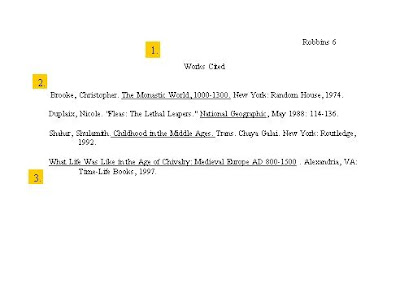 1. Type "Works Cited" one inch from the top of your page. This measurement is pretty standard for a word processor, so you shouldn't have to make any page set-up adjustments--just start typing.