MLA Parenthetical Citation Formats
The following are a few examples of parenthetical citation formats. For more detailed information, consult the MLA Handbook (6th edition) located on our bookshelves at 808.02 GIB. Please note: When using online resources, page numbers are omitted from the parenthetical citation.
*When you omit the author’s name in your sentence:
One research has found that dreams move backward in time as the night progresses (Dement 71).
*When you mention the author’s name in your sentence:
Freud states that “a dream is the fulfillment of a wish” (154).
When you use a website and mention the author’s name, OMIT the page number:
Smith states that “we are all individuals, similar but different.”
*When you cite more than one work by the same author:
One current theory emphasizes the principle that dreams express “profound aspects of personality” (Foulkes, “Sleep” 184). But investigation shows that young children’s dreams are “rather simple and unemotional” (Foulkes, “Dreams” 78).
*When the work has two or three authors:
Psychologists hold that no two children are alike (Gesell and Ilg 68).
*When the work has more than three authors:
(Rosenberg et al. 14)
*When the work has no author, begin with the word by which the title is alphabetized in the Works Cited:
Random testing for use of steroids by athletes is facing strong opposition by owners of several of
these teams (“Steroids” 22).
*When you quote or paraphrase a quotation from a book or article that appeared somewhere else:
Bacon observed that “it is hardly possible at once to admire an author and to go beyond him” (qtd. in Guibroy 113).
*When you cite a personal interview:
“Drinking milk made me a better person,” stated the artist (Vanilli). (Note: If you mention the name of your interview subject in your text, no parenthetical citation is necessary.)
*When you are citing several sources for a single passage:
There are negative implications to computerizing commercial art (Parker 2; “Art Nonsense” 43).
When you cite a character in a literary work:
Chai explains, “I reached out and smoothed out the frown lines on his forehead” (Pan 105).
When you cite a long quotation (five lines or more) that is set off from the text (Note that the quote is indented, double spaced, and without quotation marks):
No one is really certain about the origins of the term “Dust Bowl”:
H.L. Mencken in a footnote to the first supplement (1945) to his
monumental The American Language traces the term...to an Associated
Press dispatch sent by staff writer Robert Geiger on April 15, 1935. (French 3)
*When you paraphrase a whole passage or several passages, begin your citation with the author’s or article’s name and end it with the page number:
According to Brown, everytime you read an essay, you are preparing to write one. Therefore, you should pay careful attention to content and form (9).
When quoting from a website, use author (same format as print citation) or, if no author, title. Include page number, if given.
To identify the source of a quotation, paraphrase, or summary, place the author's last name in parentheses after the cited material (Harnack and Kleppinger). b Web pages number in the billions! (SearchQuest).
*These examples have been borrowed from Chico High School Library (CA) and the Purdue University On-Line Writing Lab.
Showing posts with label MLA. Show all posts
Showing posts with label MLA. Show all posts
Friday, May 1, 2009
Making In-Text or Parenthetical Citations
Many high school teachers will require students to use MLA Style for their papers. You should check with the instructor for information about line spacing, margins, and a title page, since teachers may have their own preferences.
Your teacher will probably provide a style guide of some sort to address these parts of the paper.
As you write your paper in MLA style, you will be talking about things you found in your research. Therefore, you will have to indicate in your text exactly where you found the information.
This can be done with parenthetical citations.
When you make reference to someone else's idea, either through paraphrasing or quoting them directly, you provide the author’s name and the page number of the work in the text of your paper.
This is the parenthetical citation, and it is the alternative to using footnotes (like you will do if you use other styles found elsewhere on this site).
Here is an example of parenthetical citations:
Even today, many children are born outside the safety of hospitals (Kasserman 182).
This indicates that you are using information found in a book by somebody named Kasserman (last name) and it was found on page 182.
You may also give the same information in another way, if you want to name the author in your sentence. You might want to do this to add variety to your paper:
According to Laura Kasserman, “many children today do not benefit from the sanitary conditions which are available in modern facilities” (182). Many children are born outside the safety of hospitals.
Be sure to use quotation marks when quoting someone directly.
MLA Bibliography Tutorial and Guide
Suggested Reading
Electronic SourceWriting a Research PaperUsing a Library
Related Articles
Books About MLA Style
Monday, April 20, 2009
In-Text Citation Examples & Resources
"How To" Appropriately Use MLA In-Text Citations in a Variety of Documented Writing Situations from Your Valuable Research & Research Cards
Your research cards should contain the information that you need to handle the "in-text" citation appropriately. I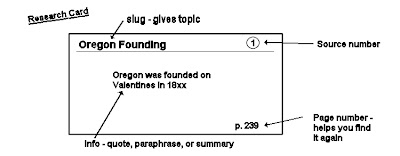 recommend that you not only provide a "slug" or "sub-headling" but--eventually--where this information will fit into your MLA Outline (i.e. II.A.1.) Notice that this sample is numbered in the right hand corner and that they page number(s) are in the bottom right hand corner. This card is a tad too thin in the amount of information that is included on it. Moreover, types of support include: direct quotations, an indirect quote, a paraphrase or a summary. Remember, though, that types of evidence include: facts, inferences, expert opinions, charts/graphs, statistics, personal experiences, interviews, and much more. I suggest that researchers include what type of evidence is being researched in the bottom right hand corner.
SAMPLE NOTECARD (ABOVE) TAKEN FROM:Denny, Rialta. "evasive4.tripod.com/notecardformat.gif." evasive4.vze.com. 13 Jan 2007.tripod.com/&h=550&w=750&sz=9&hl=en&sig2=R9Lgl_aUaYmJdkOLREQz2w&start
=2&tbnid=_Sg-Oe6fObkXNM:&tbnh=103&tbnw=141&ei=egipRYCFNJSCjAGD4pmLBg
&prev=/images%3Fq%3DMLA%2BNotecard%26svnum%3D10%26hl%3Den%26lr%3D>.
NOTE: After the first line of an MLA Work's Cited entry, the author is to indent the subsequent lines. This blog will not allow me to do so for you.
Correct Ways to Handle "In-Text" Citations
Single author named in parentheses.
Example: The tendency to come to terms with difficult experiences is referred to as a "purification process" whereby "threatening or painful dissonances are warded off to preserve intact a clear and articulated image of oneself and one’s place in the world" (Sennett 11).
Note: The punctuation here uses a direct quotation. Notice that the end quotation mark ends prior to the "in-text" citation in parentheses. Notice that there is no commo, nor an abbreviation for page number. Also notice that the parentheses are followed by the appropriate punctuation mark.
Single author or Sinlge Source named in a signal phrase.
Example: Social historian Richard Sennett names the tendency to come to terms with difficult experiences a "purification process" whereby "threatening or painful dissonances are warded off to preserve intact a clear and articulated image of oneself and one’s place in the world" (11).
Note: If you introduce the author or source in the text of your paper (and there is no duplicate in the author's name or a book with the same exact title (not likely but possible), you need only include the page number of that source and not the source itself.
Two or more authors.
Example. Certain literacy theorists have gone so far as to declare that "the most significant elements of human culture are undoubtedly channeled through words, and reside in the particular range of meanings and attitudes which members of any society attach to their verbal symbols" (Goody and Watt 323).
Corporate author (organization, association, etc.).
Example. The federal government has funded research concerning consumer protection and consumer transactions with online pharmacies (Food and Drug Administration 125).
Works with no author.
Example. Several critics of the concept of the transparent society ask if a large society would be able to handle the complete loss of privacy ("Surveillance Society" 115).
Two or more works by the same author.
Example. In his investigation of social identity, The Uses of Disorder, Sennett defines adulthood as a stage where people "learn to tolerate painful ambiguity and uncertainty" (108).
Note: The author can identify which of the two works is being referenced by signaling it in his or her writing.
In a surprising move, Richard Sennett combines the idea of power with that of virtue: "the idea of strength is complex in ordinary life because of what might be called the element of its integrity" (Authority 19).
Note: In this situation, the author signifies which of the two works is being referenced--not in the text of the writing--but by using the title of the source in the in-text citation.
Work found in an anthology or edited collection.
Note: For an essay, short story, or other document included in an anthology or edited collection, use the name of the author of the work, not the editor of the anthology or collection, but use the page numbers from the anthology or collection.
Lawrence Rosenfield analyzes the way in which New York’s Central Park held a socializing function for nineteenth-century residents similar to that of traditional republican civic oratory (222).
Bible passage.
Unfortunately, the president could not recall the truism that "Wisdom is a fountain to one who has it, but folly is the punishment of fools" (New Oxford Annotated Bible, Prov. 20-22).
Note: The author needs to include the specific Bible in the in-text citation.
Secondary source of a quotation (someone quoted within the text of another author).
As Erickson reminds us, the early psychoanalysts focused on a single objective: "introspective honesty in the service of self enlightenment" (qtd. in Weiland 42).
Note: If one author is quoted by another, this is the appropriate way to handle it.
Web page.
Abraham Lincoln's birthplace was designated as a National Historical Site in 1959 (National Park Service).
Note: Internet citations follow the style of printed works. Personal or corporate author and page number should be given ONLY if they exist on the website itself.
Other Awesome Online Sources for In-Text Citations and Work's Cited Style
http://www.bedfordstmartins.com/online/cite5.html
http://www.library.unr.edu/depts/bgic/guides/government/cite.html
http://www.lib.montana.edu/instruct/guides/
http://www.mla.com/
Your research cards should contain the information that you need to handle the "in-text" citation appropriately. I
 recommend that you not only provide a "slug" or "sub-headling" but--eventually--where this information will fit into your MLA Outline (i.e. II.A.1.) Notice that this sample is numbered in the right hand corner and that they page number(s) are in the bottom right hand corner. This card is a tad too thin in the amount of information that is included on it. Moreover, types of support include: direct quotations, an indirect quote, a paraphrase or a summary. Remember, though, that types of evidence include: facts, inferences, expert opinions, charts/graphs, statistics, personal experiences, interviews, and much more. I suggest that researchers include what type of evidence is being researched in the bottom right hand corner.

SAMPLE NOTECARD (ABOVE) TAKEN FROM:Denny, Rialta. "evasive4.tripod.com/notecardformat.gif." evasive4.vze.com. 13 Jan 2007.
=2&tbnid=_Sg-Oe6fObkXNM:&tbnh=103&tbnw=141&ei=egipRYCFNJSCjAGD4pmLBg
&prev=/images%3Fq%3DMLA%2BNotecard%26svnum%3D10%26hl%3Den%26lr%3D>.
NOTE: After the first line of an MLA Work's Cited entry, the author is to indent the subsequent lines. This blog will not allow me to do so for you.
Correct Ways to Handle "In-Text" Citations
Single author named in parentheses.
Example: The tendency to come to terms with difficult experiences is referred to as a "purification process" whereby "threatening or painful dissonances are warded off to preserve intact a clear and articulated image of oneself and one’s place in the world" (Sennett 11).
Note: The punctuation here uses a direct quotation. Notice that the end quotation mark ends prior to the "in-text" citation in parentheses. Notice that there is no commo, nor an abbreviation for page number. Also notice that the parentheses are followed by the appropriate punctuation mark.
Single author or Sinlge Source named in a signal phrase.
Example: Social historian Richard Sennett names the tendency to come to terms with difficult experiences a "purification process" whereby "threatening or painful dissonances are warded off to preserve intact a clear and articulated image of oneself and one’s place in the world" (11).
Note: If you introduce the author or source in the text of your paper (and there is no duplicate in the author's name or a book with the same exact title (not likely but possible), you need only include the page number of that source and not the source itself.
Two or more authors.
Example. Certain literacy theorists have gone so far as to declare that "the most significant elements of human culture are undoubtedly channeled through words, and reside in the particular range of meanings and attitudes which members of any society attach to their verbal symbols" (Goody and Watt 323).
Corporate author (organization, association, etc.).
Example. The federal government has funded research concerning consumer protection and consumer transactions with online pharmacies (Food and Drug Administration 125).
Works with no author.
Example. Several critics of the concept of the transparent society ask if a large society would be able to handle the complete loss of privacy ("Surveillance Society" 115).
Two or more works by the same author.
Example. In his investigation of social identity, The Uses of Disorder, Sennett defines adulthood as a stage where people "learn to tolerate painful ambiguity and uncertainty" (108).
Note: The author can identify which of the two works is being referenced by signaling it in his or her writing.
In a surprising move, Richard Sennett combines the idea of power with that of virtue: "the idea of strength is complex in ordinary life because of what might be called the element of its integrity" (Authority 19).
Note: In this situation, the author signifies which of the two works is being referenced--not in the text of the writing--but by using the title of the source in the in-text citation.
Work found in an anthology or edited collection.
Note: For an essay, short story, or other document included in an anthology or edited collection, use the name of the author of the work, not the editor of the anthology or collection, but use the page numbers from the anthology or collection.
Lawrence Rosenfield analyzes the way in which New York’s Central Park held a socializing function for nineteenth-century residents similar to that of traditional republican civic oratory (222).
Bible passage.
Unfortunately, the president could not recall the truism that "Wisdom is a fountain to one who has it, but folly is the punishment of fools" (New Oxford Annotated Bible, Prov. 20-22).
Note: The author needs to include the specific Bible in the in-text citation.
Secondary source of a quotation (someone quoted within the text of another author).
As Erickson reminds us, the early psychoanalysts focused on a single objective: "introspective honesty in the service of self enlightenment" (qtd. in Weiland 42).
Note: If one author is quoted by another, this is the appropriate way to handle it.
Web page.
Abraham Lincoln's birthplace was designated as a National Historical Site in 1959 (National Park Service).
Note: Internet citations follow the style of printed works. Personal or corporate author and page number should be given ONLY if they exist on the website itself.
Other Awesome Online Sources for In-Text Citations and Work's Cited Style
http://www.bedfordstmartins.com/online/cite5.html
http://www.library.unr.edu/depts/bgic/guides/government/cite.html
http://www.lib.montana.edu/instruct/guides/
http://www.mla.com/


Wednesday, April 15, 2009
Works Cited Entries & Source Card Style
Works Cited Entries & Source Card Style
Duke Universities Libraries Site
This is a great site to help you understand how to handle "in-text" citations and "works cited" entries. Please make sure that you choose the Modern Language Association (MLA) entry. This site shows students how to handle "works cited" entries for a variety of other styles: APA, Chicago, Turabian and CSE. Scroll down for web-site link.
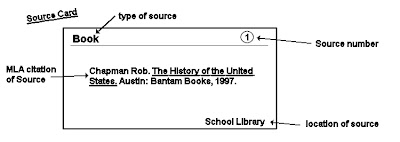
Pay close attention to the guidelines given at the bottom of each entry for specific important information that you must gather for each of the different types of sources.
Note: I would recommend that you letter and not number each of your souces. I think it is easier to keep them separate. Then, when you tie a notecard to a source you can use a letter and a number in the upper, right hand corner to indicate "which" source your note cards came from. Also note that the second line (and all others after it) of this MLA Entry should be indented. I also find it important to list the ISBN number, call number or location in the bottom left corner if one needs to find the source again for reference.
Journals: Printed Journals, Journal Article with Multiple Authors, Information from an Online Journal, Full-Text Article from a Database.
Magazines: Printed Magazines, On-Line Magazines, Full-Text Article from a Database.
Books: Book with a Single Author, Book with Two Authors, Book with Three or More Authors, Electronic Book, Article from Within a Book, Encyclopedias and Other Multi-Volume Books.
Do you want even more help? See Noodle Tools and Son of Citation Machine below.
Noodle Tools
Noodle Tools is a free tool to easily create MLA Works Cited pages. You need to go to the homepage, sign up for a free account and the site will take you through all of the other steps. Try it! You'll love it.
http://noodletools.org/
Son of Citation Machine
Citation Machine is one of many on-line cites that will assist a student who has gathered all of the "vital" information about sources: journals, books, newspapers, primary sources, other sources. Please have all of the important information collected if you want this "short-cut" to work for you. Also, make sure that you choose MLA as your "style".
http://citationmachine.net/
Duke Universities Libraries Site
This is a great site to help you understand how to handle "in-text" citations and "works cited" entries. Please make sure that you choose the Modern Language Association (MLA) entry. This site shows students how to handle "works cited" entries for a variety of other styles: APA, Chicago, Turabian and CSE. Scroll down for web-site link.

Pay close attention to the guidelines given at the bottom of each entry for specific important information that you must gather for each of the different types of sources.
Note: I would recommend that you letter and not number each of your souces. I think it is easier to keep them separate. Then, when you tie a notecard to a source you can use a letter and a number in the upper, right hand corner to indicate "which" source your note cards came from. Also note that the second line (and all others after it) of this MLA Entry should be indented. I also find it important to list the ISBN number, call number or location in the bottom left corner if one needs to find the source again for reference.
Journals: Printed Journals, Journal Article with Multiple Authors, Information from an Online Journal, Full-Text Article from a Database.
Magazines: Printed Magazines, On-Line Magazines, Full-Text Article from a Database.
Books: Book with a Single Author, Book with Two Authors, Book with Three or More Authors, Electronic Book, Article from Within a Book, Encyclopedias and Other Multi-Volume Books.
Newspaper Articles: Printed Newspapers, Online Newspapers, Full-Text Article from a Database.
Primary Sources: Letters, Interviews, Motion Picture, Online Digitized Collection.
Other Materials: Web Page, Online Posting, Email Message, Book Reviews, Government Documents
http://www.lib.duke.edu/libguide/cite/works_cited.htm
Do you want even more help? See Noodle Tools and Son of Citation Machine below.
Noodle Tools
Noodle Tools is a free tool to easily create MLA Works Cited pages. You need to go to the homepage, sign up for a free account and the site will take you through all of the other steps. Try it! You'll love it.
http://noodletools.org/
Son of Citation Machine
Citation Machine is one of many on-line cites that will assist a student who has gathered all of the "vital" information about sources: journals, books, newspapers, primary sources, other sources. Please have all of the important information collected if you want this "short-cut" to work for you. Also, make sure that you choose MLA as your "style".
http://citationmachine.net/
Tuesday, June 12, 2007
Sample MLA Works Cited List
A standard MLA paper requires a works cited list. This is the list of sources you used in your research. It is similar to a bibliography.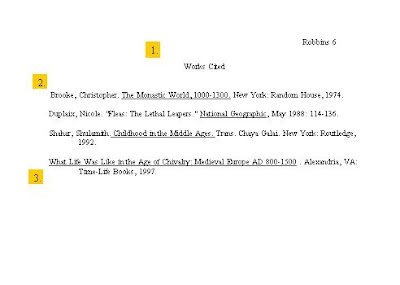 1. Type "Works Cited" one inch from the top of your page. This measurement is pretty standard for a word processor, so you shouldn't have to make any page set-up adjustments--just start typing.
2. Type in the information for each source, double spacing between the works. Alphabetize the works by author. If there is no author or editor mentioned, use the title (as in the last example on the list).
3. Once you have a complete list, you will format so that you have hanging indents. To do this: highlight the list, then go to Edit and find the command for Hanging.
Go to Bibliography Tutorial
MLA Image Page/Appendix Page
Formatting a Page With a Figure
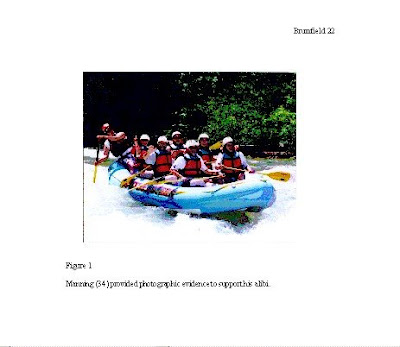
MLA style guides can be confusing. This page shows you how to create a page with an image display.
Images (figures) can make a big difference in a paper, but students are often a little hesitant about including them. This page shows you the correct format for inserting a page with a figure. Be sure to assign a number to each figure.
Alternate First Page
This format the alternate format for papers that contain a title page. Use This Format If Your Paper Has a Title Page

This format the alternate format for papers that contain a title page.
MLA papers do not typically contain a title page. If your teacher does require a title page, you should use this format for your first page.
Double space after your title and begin your report. Notice that your last name and the page number will go at the right top corner of your page in a header.
Go to Using Parenthetical Citations
Title Page in MLA
If your teacher requires a title page, you can use this sample as a guide.

Space 9 lines down from the one-inch top margin. This will give a 2 ½ inch top margin.
Center your persuasive MLA title 9 lines down from the top.
Space 15 lines
Center the word "by" centered on the page
Double-space
Center your name on the page
Space 15 lines
Center the class name and period number on the page.
Double space
Center your teacher's name on the page.
Place your class information about two inches below your name.
MLA Outline
MLA style can be difficult to understand, but many students learn easily when they see an example. The outline follows the title page.


The MLA outline should include the small letter "i" as a page number. This page will precede the first page of your report.
Center your title. Below the title provide a thesis statement.
Double space and begin your outline, according to the above sample.
Double space and begin your outline, according to the above sample.
MLA Sample First Page
A title page is not required in a standared MLA report. The title and other information go on the first page of your report.
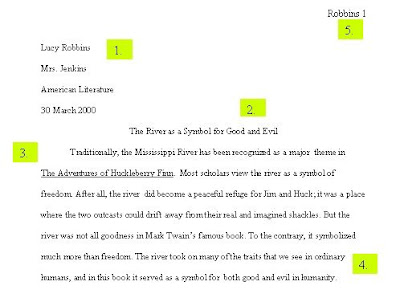
Begin typing on the top left of your paper. Use 12 point Times New Roman font.
1. Place your name, your teacher's name, your class, and the date. Double space between each item.
2. Next, double space down and type your title. Center the title.
3. Double space below your title and begin typing your report. Indent with a tab.
4. Remember to end your first paragraph with a thesis sentence!
5. Your name and page number will go in a header at the top right corner of the page. You can insert this information after you type your paper. To do so in Microsoft Word, go to view and select header from the list. Type your information in the header box, highlight it, and hit the right justify selection.
Go to Using Parenthetical Citations

Monday, February 12, 2007
Sample Works Cited Format
Here's a sample of what a Work's Cited page should look like for your paper or speech. There are other entries on the cite to answer this question.
CLICK HERE TO GO DIRECTLY TO THE SAMPLE WORK'S CITED SITE THAT PROVIDED THIS INFORMATION
You can cut and paste that information into a Word Document and then enter your information.
If you don't know how to do a Work's Cited entry, go to
(1) CITATION MACHINE or SON OF CITATION MACHINE. Click here to go to this site that will help you create an MLA Work's Cited Entry.
(2) Once there, click on MLA (Modern Language Association). DO NOT CHOOSE APA or CHICAGO. Click here to take you directly to the MLA portion of the site
(3) Choose the type of entry (on the right: electronic, print, etc.), then enter your information. When you hit the SUBMIT BUTTON, the cite will show you what your entry should look like. Cut and paste that into your Word Document.
CLICK HERE to go directly to the Capital Community College Website for "An Introduction to MLA Research Techniques."
CLICK HERE TO GO DIRECTLY TO THE SAMPLE WORK'S CITED SITE THAT PROVIDED THIS INFORMATION
You can cut and paste that information into a Word Document and then enter your information.
If you don't know how to do a Work's Cited entry, go to
(1) CITATION MACHINE or SON OF CITATION MACHINE. Click here to go to this site that will help you create an MLA Work's Cited Entry.
(2) Once there, click on MLA (Modern Language Association). DO NOT CHOOSE APA or CHICAGO. Click here to take you directly to the MLA portion of the site
(3) Choose the type of entry (on the right: electronic, print, etc.), then enter your information. When you hit the SUBMIT BUTTON, the cite will show you what your entry should look like. Cut and paste that into your Word Document.

MLA Work Cited for this Post
Darling, Charles. "A Sample Works Cited Page." A Guide for Writing Research Papers Based on Modern Language Association (MLA) Documentation. CAPITAL COMMUNITY COLLEGE. 11 Feb 2007
CLICK HERE to go directly to the Capital Community College Website for "An Introduction to MLA Research Techniques."
Subscribe to:
Posts (Atom)