Tuesday, March 3, 2009

DAILY ORAL LANGUAGE: ACT Preparation--Grammar, Usage & Mechanics & Rhetorical Skills Quiz 1

Daily Oral Language Assignments

Each day of Mr. McLaughlin's English 10B Class will begin with a short "sponge" activity. On some days we will begin with the ACT preparation assignments like the ones listed in this entry.

On other days we will be working with ACT/SAT Vocabulary words. For your convenience & for your study, these are being posted here for your convenience and to study for our in class quizzes.

Your learning of this material will be covered on our quizzes. We will have a quiz each two weeks.


COMPLETE ACT TEST PREPARATION.doc

ACT Test Preparation Passage I.1, Day 1.doc

ACT Test Preparation Passage I.2, Day 2.doc

ACT Test Preparation Passage I.3, Day 3.doc

Monday, December 1, 2008

English 10B Vocabulary: Unit 2 SAT/ACT Words

2.1 ARDUOUS (Ahr joo us) hard, difficult, tiresome
Memory link: the arduous snow covered trail is hard on us

It was an ARDUOUS climb up the 5 mile hill.

The pace of the track meet was ARDUOUS and left many runners tired and ready to go to sleep.

The assignment given the recruits was ARDUOUS, twenty miles with full packs in the hot sun.


Swimming three miles was the most ARDUOUS excersize Jeannie ever had.


The long, ARDUOUS boat trip was made even worse by stormy seas and much seasickness.


It was the most ARDUOUS puzzle I had to ever solved, it took days to solve it.

2.2 ASUNDER (uh SUN dur) separate parts; apart from each other in position
Memory link: The thunder tore the young lovers asunder

Friday, December 5, 2008

The big storm made the houses all ASUNDER. Nothing was one piece anymore.

When the earthquake stopped, and we came up from our shelter, we found the city had been torn ASUNDER and not one single building was left standing.


Our team lost its unity and became a group of individuals who played entirely for themselves, ASUNDER from each other.

Bowling pins ASUNDER from each other when the ball hit them.

Their relationship was brought to an ASUNDER; they couldn’t be together any longer.


2.3 ASKEW (uh skew) to one side; crooked; awry; a sidelong look of contempt
Memory link: Curlys pool cue had become askew.Friday December 7, 2007
Thursday, December 4, 2007


Our backbones have an ASKEW bend to them.

After the flood receded, the bridge was found to be ASKEW of the road which connected to it.


The tire wouldn't fit on the car beacause in the accident the axle had been bent ASKEW.


The speaker looked ASKEW at the heckler at every interruption.

Marcy looked at Jan with an ASKEW look because she said a rude comment.

The picture was too ASKEW; nothing fit together.

2.4 BELEAGUER (be Lee gur) to besiege; beset; surround, harass
Memory link: the little leaguers beleaguered the big leaguers.
Friday, December 5, 2007.

The ants BELEAGUERED the ham sandwich at the picnic.

In World War II, the Russian city of Staligrac was BELEAGUERED by the German ARmy for five months before it fell to the Germans.


During his last year in office, Richard Nixon was a BELEAGUERED president, struggling to fight off the Watergate scandal.


In the midst of important negotiations, the union official asked his staff not to BELEAGUER him with insignificant details.

Tom BELEAGUERED Jimmy at recesses all day long. Jimmy cried.

My mom was BELEASGUERING me with many questions so I told her to back off.

2.5 DULCET (DULL set) melodious, soft, soothing
Memory link: If you don’t like opera, even the most Dulcet tones of the finest sopranos make for a dull sit.

The DULCET sound of her voice could put any baby to sleep.


Senator Kramer was a political campaigner who could hypnotize an audience with sweet words and DULCET tones.


Jeff's parents declared there was nothing DULCET about the rock-and-roll music that shook the house from his room every morning as he dressed for school.


The radio therapists voice was DULCET and calmed her listeners down and made them comfortable sharing their problems on the radio with thousands of listeners.

Some people need "white noise" to sleep as they find it DULCET. It doesn't work for me and drives me crazy. I need the room to be silent to sleep.

2.6 EFFACE (uh FACE) to rub away
Memory link: how to efface a face by erasing it

Sometimes people who commit crimes will EFFACE all evidence.

We came upon a cemetary by the sea. Many of the headstone inscriptions had been EFFACED by the ravages of time, but we could make out many that were well over two hundred years old.


To assure that he left no clues, the thief EFFACED his fingerprints from the stolen car.


Someone vandalized the museum paintings by EFFACING each one with red spray paint.

Over the years, the color on the pictures started EFFACING slowly.

I EFFACED the dirt off my arms.

2.7 HISTRIONIC (his tree AHN ik) overly dramatic, theatrical
Memory link: Professor Bradley likes his history on the histrionic side

Jess was always HISTRIONIC about everything. Even about the littlest things possible.


As soon as you would mention thw word wrinkle the middle-aged actress would fall into a state of HISTRONIC tears.


Everything Michael said was on the swaggering, HISTRONIC side, as if he were the coolest guy on campus.


The children's HISTRONICS when they couldn't find their toys made everyone uncomfortable.


The HISTRIONICS within the movie made it more exiting.

The movie was too HISTIONIC for me too handle.

2.8 MILIEU (mill you) environment or surroundings
Memory link: the boys’ locker room showers were a milieu of mildew

After a long sea journey, a sailor on land for the first days feels out his MILIEU.

The proper MILIEU for raising a family is a home setting with loving parents who understand child rearing; something every parent must work at and not take for granted.

I always love the MILIEU in an airplane; its always friendly.

Its always a good MILIEU when the house is clean.


The New York Stock Exchange is a MILIEU of frenzied activity during trading hours.


2.9 PORCINE (pore sein) reminiscent of or pertaining to a pig
Memory link: it was a poor scene when mark arrived with his porcine date
Thursday, December 4, 2007

Her skin had a PORCINE color that bugged me.

After an around the world cruise, where each meal is a grand feast, Bob and Helen returned home with PORCINE figures.


She had a PORCINE attitude about food; that is to say she would eat anything and everthing.


Over the college years he has gotten the PORCINE. look.

Bob was a PORCINE when it came to food but he was still skinny.


2.10 QUIXOTIC ( kwik SAHT ik) idealistic and totally impractical
Memory link: Jim, the messenger, is not idiotic, he’s just quixotic.
Wednesday, December 3, 2007

Her freinds thought her QUIXOTIC when planning big parties; she just loved to dream big.


Professor Callan said it is QUIXOTIC of society to ignore the world's environmental problems.


Puttingall taxpayers on the honor system is a QUIXOTIC suggestions.


Sue had the most QUIXOTIC ideas of what her life would be like if she ever won the lottery.

The man's behavior was QUIXOITIC, he sat outside of mcdonalds thinking he would get free big macs everyday.


Sunday, October 26, 2008

Demonstration Speech Topic Selection

CRITERIA FOR CHOOSING A DEMONSTRATION SPEECH TOPIC

The goals of your demonstration speech could be: to demonstrate a process and give the audience information while using visual aids; or to show how to do something; or how something is done; or how to make something; or how something works.

Choose a topic that you know and enjoy. Your speech will be more successful and easier to do if you use this criteria. If you can't come up with good public speaking topics for a demonstrational presentation speech, then use the subjects listed below for inspiration.

Before You Take that Step, Consider the following:


-Is it something you know how to do well?
-Is it something your audience would like to learn?
-Is it a process that can be done in the classroom with the materials that we provide? (table, blocks, cutting board, knives, refigerator, freezer, microwave--please DO NOT bring knives to schooo)
-Is it a process that will result in a finished product?
-Is it something you can accomplish in the allotted time? (5-7 minutes)
-Is it something you can safely accomplish in the room?
-Is it something you can do legally in school? (no weapons, animals, alcohol or controlled substances)
-Which of your choices have enough potential to offer your audience valuable information?

Remember audience when you choose your topic.

Who are they?
What are their interests?
What do they like?
What are their needs?
Use these lists of demonstrative speech topics to develop your own topics for a demonstrative speech. It can be anything you like. As long as you are able to present the steps of the demonstration or process speech topics.
Topic Ideas--Food--Demonstrate HOW TO:

bake a pie,
decorate a cake,
make a non-bake cookies,
make a favorite family cookie,
make a better than hitting the lottery cake,
make different flavors of beef jerkey,
make an icee,
make puppy chow,
make a fruit cake,
make blueberry pancakes,
make muffins,
grill a steak,
make seven-layer dip,
make a Caesar salad,
make an Orange Julius,
make variations on grilled cheese,
make an omelette,
make a smoothie,
make homemade ice-cream,

Topic Ideas--Non Food

HOW...

to set a dinner table for a formal dinner,
to plan the perfect date,
to make a pinata,
to pot or repot a plant,
to make a birdhouse,
to arrange flowers,
to polish shoes,
to stencil glass,
to make stationary,
to stamp greeting cards,
to make ornaments,
to color eggs,
to scrapbook,
to make a photo album,
to paint a shirt,
to make paper flowers,
to do wood burning,
to frame a picture,
to make boxes,
to make a dream catcher,
to finish furniture,
to hang wallpaper,
to make a basket,
to make a spool doll,
to make an Easter tree,
to make a dryer vent pumpkin,
to fix a bike tire,
to iron clothes,
to cross stitch,
to make a terrarium,
to set up a fish tank,
to tie a tie,
to make a wreath,
to wrap a package creatively,
to silk screen,
to carve wood,
to tool leather,
to repair a lamp,
to make a winter survival kit,
to carve a pumpkin,
to make a centerpiece,
to make a beaded necklace,
to make paper,
to tie dye,
to braid a belt,
to make candy airplanes or trains,
to make a wooden stool,
to make Playdough or Silly Putty,
to make a planter,
to dry flowers
to be a vegetarian
to fix a flat tire
to create a Halloween mask
to clean your car
to play piano
to change a bank cheque
to dress for a dance
to play a computer game
to make a blog
to make a web site
to organize a surprise party
to print a digital photo
to eat oysters
to register for voting
to make special coffee drinks
to read music notes
to learn playing guitar
to use your breath when you sing
to make your own root beer
to make your garden full of flowers year around
to build a resume
to clean your swimming pool
to clean your golf clubs
to make a fast summer salad
to make a new candle of old ones
to make your own wedding dress
to organize your wedding
to make a water-colour
to build a shed
to prevent injury
to develop the best serve in a tennis game
to knot a carpet
to manage stress
to relax
to become a good actress
to become a famous filmstar
to write a filmscript
to write a business-like letter
to harvest honey
to serve breakfast in bed
to blow a glass
to train your brains
to make a genealogical tree
to start a bed & breakfast
to become a policeman
to climb a building
to planning a party
to run a formal meeting

or demonstration speech topics related to yóur favorite sports
And so on ...

Other Ways to Get Ideas

Another way of inventing demonstration speech topics is by associating. Look at the general categories below. Can you come up with any good how to demonstrative speech ideas?
Food and Drink, Household, Sports, Recreation, Health & Beauty, Home Improvement, Decoration, Cars, Government Science, Nature, College Games, Culture, Etcetera ...

Delivery Of Your Demonstration Speech Topics

First and for all: think about the rules and time limit of the public speaking assignment. And apply these eight public speaking speech tips for delivering your demonstration speech topics:

1. Visual aids, like objects, actual items, models or drawings can help you.
2. Include personal stories and examples to illustrate your topics for a demonstrative speech.
3. Provide each audience member materials and ingredients to practice with.
4. Insure everyone is participating.
5. Look around you and see if your audience is following you.
6. Ask yourself if someone in the audience has to assist with your demonstration.
7. Close your speech with a memorable summary.
8. Ask if there are any questions about your demonstrative speech topic ideas.

By now, you developed a blueprint for a good demonstration speech topic.

CLICK HERE for a cool on-line topic selection tool. Or scroll down for Mr. McLaughlin's list of topics.

Didn't get your topic in the book? CLICK HERE to send an email reserving your topic.

Have another idea to add to the list? CLICK HERE and if it's good, we'll add it to the list.

Wednesday, October 1, 2008

The LCHS Opinion/Conviction Speech

YOUR OPINION & CONVICTION SPEECH IN SPEECH I

Originally Posted September 24, 2007 this term. Posting date changed to place the article higher on the blog for student's convenience.

Choose a topic about which you have a strong opinion. Remember, topics are first-come, first-served. Only one speech per topic, per class.

It is our goal in this speech to teach you how to support an opinion and make an argument with support. Don't be afraid of this, though. You already do this all the time. Everytime you reach a conclusion about something, your personal experiences or the experiences of others lead you to your conclusion.

You will share your opininion for the rest of your life. We want to make sure that our graduates know how to share valid opinions in public. Remember, an opinion by itself without support may let others see you as uneducated. Years from now when you're on a church council, a scout leader, a member of the PTA, local government or you're just visiting with family, what we learn here will serve you. THIS IS EASIER THAN MANY OF YOU WILL WANT TO MAKE IT. RELAX, YOU CAN DO THIS!

This IS NOT a researched speech. It is a speech that you will support with your own experiences, the experiences of friends, of family members or others. You will need three "reasons" why your opinion is valid. Then you will need to support your reasons with stories or personal experiences.

ON-LINE VERSIONS OF THINGS WE LEARNED IN CLASS

Don't understand the Introduction, Conclusion or How to Build a Main Point? Click here for more information.

ELIGIBILITY: To be eligible for this 3-6 minute Opinion Speech you need to have the following pieces complete that are listed as REQUIRED. Some of these links are to help you find information quickly on our blog to help you and are not required.

TOPIC SELECTION

(1) CLICK HERE to send an E-Mail to Mr. M. with your topic if it is not in the book. It must be put in the book and compared to other topics there. Remember, first come, first served. REQUIRED FOR THIS SPEECH: Your topic must be in the classroom book and must be approved by the instructor.

PRE-SPEAKING BLOCK

(2) CLICK HERE for a "review" on how to write a Pre-Speaking Block with a General Purpose and a Specific Purpose (known as the Pre-Speaking Block). REQUIRED FOR THIS SPEECH: A Pre-Speaking Block done before you begini writing your speech. This helps you make good speech writing choices.

(3) CLICK HERE for a "review" on how to write an Audience Analysis Statements as we taught in the last speech. REQUIRED FOR THIS SPEECH: An Audience Analysis Statement of an audience that is made up of students, teachers, parents, administrators, school board members and citizens.

INTRODUCTION

(4) CLICK HERE for a "review" of the five goals one should achieve in writing a good introduction. REQUIRED FOR THIS SPEECH: A manuscripted Introduction.

(5) CLICK HERE for a "review" of the types of Attention Getters (with examples) that we learned in class during the Peer Biography Speech. REQUIRED FOR THIS SPEECH: Three Attention Getters that are at least four sentences long each.

(6) CLICK HERE for a "review" on how to write a thesis statement as was taught in class. REQUIRED FOR THIS SPEECH: A thesis statement made with a salutation, thesis base and strong preview.

(7) CLICK HERE for a "review" of how to write a relevance statement. REQUIRED FOR THIS SPEECH: A relevance statement that includes three different reasons for the audience to listen. This is a minimum. More is fine.

(8) CLICK HERE for a template showing how to complete the three required bulletin boards. REQUIRED FOR THIS SPEECH: A completed bulletin board for each of your main points.

(9) CLICK HERE for the required manuscripted Introduction Template. REQUIRED FOR THIS SPEECH: A one-sheet manuscripted introduction.

BODY

(10) CLICK HERE for the required T-Chart/Template for MP I of your Opinion Speech. REQUIRED FOR THIS SPEECH: An important reason (T-Chart) for the "more important argument that you will offer."

(11) CLICK HERE for the required T-Chart/Template for MP II of your Opinion Speech. REQUIRED FOR THIS SPEECH: A more important reason (T-Chart) for the "more important argument that you will offer."

(12) CLICK HERE for the required T-Chart/Templage for MP III of your Opinion Speech. REQUIRED FOR THIS SPEECH: The most important reason (T-Chart) for the "most important argument that you will offer."

(13) CLICK HERE for another copy of the rubic given to you in class. You need this signed by a parent/adult showing that you discussed or delivered this speech for an adult.

(14) CLICK HERE for the required manuscripted Conclusion Template. REQUIRED FOR THIS SPEECH: A manuscripted conclusion of the speech.

(15) CLICK HERE for a "review" of the things any good speaker/writer should accomplish in a good conclusion as we learned in class.

(16) CLICK HERE for a "review" of the types of clichers with examples that one might use for a speech. These were recently taught in class. REQUIRED FOR THIS SPEECH: A strong clincher that effectively leaves the audience with a final thought or a series of final thoughts.

(17) CLICK HERE for examples of the types of evidence and support that one should us to support his/her opinions with evidence. The opinion speeches should be supported by evidence. REQUIRED FOR THIS SPEECH: Two pieces of support at minimum for each of the Main Points in the speech.

GENERAL

(18) CLICK HERE for an overview of what each TEMPLATE should contain. REQUIRED FOR THIS SPEECH: Five template styled pages to carry to the podium with you that encourages "extemporaneous speaking."

ELECTRONIC COPIES OF SPEECH OPINION RUBRICS
TO BE USE IN SELF, PARENT AND INSTRUCTOR EVALUATION

Opinion Speech Self-Evaluation.doc

Opinion Speech Teacher Evaluation page 1.doc

Opinion Evaluation Speech Teacher Evaluation page 2.doc

Opinion Speech Pre-Speaking Block

Opinion Speech Pre-Speaking Block & Modified Thesis

For today's homework you need to write a GP, an SP and an AAS for you Opinion Speech. I also need you to brainstorm on a web/map 5 reasons that your opinion should be supported by others. And by others we mean that you should consider other students, teachers, school administrators, parents, community patrons and school board members.

For the first speech we taught you to write a thesis the following way:

Today I will insert general purpose (entertain, inform, persuade, convince, etc.) you that insert subject and opinion of subject by insert -ing word (examining, discussing, studying): (1) insert first main point; (2) insert second main point; (3) insert third main point; and (4) insert fourth main point.

For this speech you will need to write a revised thesis (without the "Today I will and GP")

The revised and less rigid thesis should look like this. This is closer to what a thesis should look like in your writing:

Start by stating your subject and your opinion of your subject--Thesis Base (short and to the point) as can be seen by insert -ing word (examining, discussing, studying): (1) insert first main point; (2) insert second main point; (3) insert third main point; and (4) insert fourth main point.

Tuesday, January 22, 2008

Monroe's Motivated Sequence Model/Sample Paper

IMPORTANT NOTE--PLEASE READ: Please take a look at the following persuasive speech manuscript to help you understand how to put Monroe's Motivated Sequence together. It is important to note the use of pronouns in this speech. Although "I", "me", "mine", and "you" may be appropriate for a speech, USING THESE IS NOT APPROPRIATE FOR A FORMAL MLA RESEARCH PAPER. Avoid using these pronouns in your paper which should be more expository in nature.

An example of Monroe’s Motivated Sequence
A Friend in Need

Sandy Hefty

Paragraph 1--Loretta Olson sometimes gets confused and does some pretty bizarre things. For instance, sometimes she puts her ice cream in the refrigerator instead of the freezer, and sometimes she feeds her cat chocolate chips instead of cat food. You see, Loretta is an 85-year-old woman who suffers from Alzheimer’s disease. She was preceded in death by her husband and only child and now is trying to live on her own the best that she can. You may be wondering how somebody as confused as Loretta could possibly keep living on her own, but she does.

Paragraph 2--During my freshman year, I volunteered six hours a week to help Loretta remain independent in her home. Due to the forgetfulness associated with Alzheimer’s disease, my main duty as a volunteer was to help Loretta with her cooking and house cleaning, which she often forgot to finish on her own.

Paragraph 3-- Since I started volunteering time with Loretta, I’ve learned that there are millions of elderly Americans who need help to remain independent in their homes. According to the United States Census Bureau, our elderly population is the fastest growing segment in the nation. This trend is even seen in my class survey, in which all but two of you said you have living grandparents and seven of you said you have grandparents living alone.

Paragraph 4-- Although the elderly are no longer the poorest segment of American society, according to the Poverty and Wealth Branch of the United States Census Bureau, 1.8 million Americans in the 75-plus age group fall below the poverty line. One point eight million—that’s roughly the populations of Seattle, Indianapolis, and Boston combined.

Paragraph 5-- Today, I would like to persuade each of you to help solve the problems facing more advanced and less fortunate elderly Americans by volunteering time to help them remain independent in their homes. Let’s begin by addressing the problems that can occur among this group of people.

Paragraph 6-- There are two problems that can occur when elderly people living alone do not get the companionship and care they need. The first problem is that elderly people may not be able to meet all of their physical needs. Before I met Loretta, I was a caregiver for an 87-year-old woman who suffered from arthritis. This woman often needed help buttoning her blouse and tying her shoes, as well as needing help cutting vegetables for meals and doing light house cleaning. This is not unusual for many people of advanced age. Like Loretta, they can continue living at home, but need help with certain physical tasks such as house cleaning, food preparation, and transportation.

Paragraph 7-- Not only is there the problem of elderly people not meeting all of their physical needs, but there is a second, more tragic problem that can occur. That second problem is suicide. According to the National Center for Vital Statistics, persons age 75 and older have the highest rate of suicide compared to all other age groups. Anthony Boxwell, author of the article entitled “Geriatric Suicide: The Preventable Death,” says that suicide among the elderly stems from three main causes—helplessness, hopelessness and haplessness. Helplessness describes the feelings of impotence some elderly people feel after retirement or upon realizing they’re losing their physical and mental vigor. Hopelessness is associated with depression caused by the realization of the onset of old age. And haplessness refers to a series of repeated losses, such as loss of earnings, friends, and family.

Paragraph 8-- Now that we have talked about the two major problems facing elderly people who do not get the companionship and care they need, let’s talk about what we can do to help solve these problems.

Paragraph 9--We as individuals can’t do everything, of course. Some responsibility lies with families, government, and charitable agencies. But there is something we can do, and that is get involved with a volunteer program that assists elderly people who need help living at home. Here in Wisconsin, we have a Community Options Program, which is an individually tailored financial assistance method to help keep the elderly and people with disabilities out of nursing homes. Right here in Madison, Independent Living has a Friendly Visiting Program in which volunteers provide companionship and household assistance for elderly people who live at home. You can contact Independent Living by calling the number on this handout, which I will be giving you after my speech.

Paragraph 1o-- Now I’m sure you have some questions about this kind of work. For instance, how much time does it take? It takes as much time as you want to put into it. You can volunteer as little as one to two hours a week or as many as forty hours a week. You decide how much time you want to volunteer based on your own schedule. But no matter how much time you spend, you will certainly experience great personal gratification. I know I have. I have been a volunteer for six years, and volunteering time with people who are less fortunate than I makes me feel good about myself. Volunteering time with the elderly has also taught me unique ethnic traditions, as well as American history.

Paragraph 11--You should also know that this kind of volunteer work can have benefits for you beyond feelings of personal gratification. Some volunteer organizations such as the state-run Community Options Program and the federally funded Title 19 Program offer financial assistance to people who participate. This can run from reimbursement of your travel expenses to an actual salary for certain kinds of work.

Paragraph 12-- In closing, I am urging you to volunteer time to help needy elderly people remain independent in their homes. Remember that spending time with elderly people living alone can help them meet their physical and emotional needs. You can adjust the time spent to fit your needs, you can get great personal gratification, and you can even receive monetary benefits as well. But most important, Loretta Olson—and millions like her—will be forever thankful for your efforts.
A Friend in Need by Sandy Hefty


Commentary

“A Friend in Need” is a persuasive speech on a question of policy. In addition to illustrating many of the methods of persuasion discussed in the textbook, it provides a helpful model of how students can use Monroe’s motivated sequence to organize persuasive speeches that seek immediate action. Here is a synopsis of it.

Specific Purpose: To persuade my audience to volunteer time to help needy elderly people remain independent in their homes.

Central Idea: By participating in a volunteer program, college students can help needy elderly people continue to live independently in their homes.

Method of Organization: Monroe’s motivated sequence

Introduction: The introduction consists of paragraphs 1-5. The opening story about Loretta Olson gets the audience’s attention and also contains a gentle trace of humor. When the speech was delivered in class, several members of the audience chuckled as they identified Loretta Olson’s forgetfulness with the memory lapses experienced by some of their elderly relatives. In paragraph 2 the speaker explains her personal involvement with the topic and, at the same time, establishes her credibility and good will.

In paragraphs 3 and 4 the speaker uses statistics from the U.S. Census Bureau to establish the importance of the topic. Her comparison, in paragraph 4, between the 1.8 million Americans in the 75-plus age group who fall below the poverty line and the combined populations of Seattle, Boston, and Indianapolis is an excellent illustration of how speakers can translate large numbers into figures that are more meaningful to the audience. It is also worth noting how, in paragraph 3, the speaker relates the topic to her audience by mentioning the results of her class survey, which showed that almost all of her classmates had living grandparents. Paragraph 5 ends the introduction by stating the speaker’s central idea and providing a clear lead-in to the body of the speech.

Body: After getting the attention of her audience in the introduction, the speaker begins the body of her speech in paragraphs 6 and 7 with the second step in Monroe’s motivated sequence—showing the need for a new course of action. In paragraph 6 the speaker explains that many elderly people cannot meet all of their physical needs, and she illustrates the point with an example of an 87-year-old woman whom she helped as a caregiver. Had she had more time, she could have provided more support for this point, but, as in most classroom speeches, she had to develop her points crisply and concisely.

In paragraph 7 the speaker continues with the need step of Monroe’s motivated sequence by discussing the tragic problem of suicide among the elderly. After presenting figures from the National Center for Vital Statistics showing that persons age 75 and older have the highest suicide rate in the U.S., she provides testimony from Anthony Boxwell about the causes of suicide among the elderly. As in other parts of the speech, the speaker uses credible evidence and identifies her sources for the audience.

After an excellent transition in paragraph 8, the speaker moves to the satisfaction step of the motivated sequence by explaining, in paragraph 9, how students can participate in volunteer programs to help the elderly. Rather than talking in abstract terms, the speaker relates her plan to her classmates at the University of Wisconsin by focusing on state and local programs in which they can get involved. After the speech, she provided her audience a handout identifying volunteer agencies they could contact.

Of course, getting an audience to agree that something should be done and getting an audience to do something are two different matters. In paragraphs 10 and 11, therefore, the speaker turns to the visualization step of the motivated sequence by showing the audience the practicality of getting involved in a volunteer program to help the elderly. She explains that students can readily adapt their volunteer work to their personal schedules, that they will experience substantial personal gratification from volunteering, and even that they might be able to receive financial assistance for their efforts. Had the speaker failed to address these issues, her speech would have been much less effective.

Conclusion: The speaker concludes with the final step in Monroe’s motivated sequence—an appeal to the audience to take action. After quickly summarizing her main points, she closes with the poignant statement that “Loretta Olson—and millions like her—will be forever thankful for your efforts.” The emotional appeal of this line, in combination with the sense of psychological unity gained by referring back to the opening example, closes the speech on a strong note.

Saturday, January 19, 2008

Using Monroe's Motivated Sequence to Persuade: Detailed Model

* IF YOU'RE HAVING PROBLEMS, READ ALL THE WAY DOWN.
**You will need to use this time-tested organizational pattern to organize your persuasive speech. This matches the sample outline that was sent to you on Monday 02/18/2007.

***You need a Work's Cited page. I need to hear a minimum of FIVE different sources TAGGED in your speech.


****To be eligible, you will need a pre-speaking block, complete sentence outline, a scripted & labeled introduction, a scripted & labeled conclusion, a visual aid that is a chart, graph, etc. that contributes to us understanding some aspect of your speech.
PRE-SPEAKING BLOCK: Give us a MLA Heading, a title, a GP, a SP and an AAS. Still confusing? It should be in your notes. But, it's also here on the blog.

ATTENTION STEP: Get the attention or your audience as we've done all term. This can be done with a detailed story, shocking example, dramatic statistic, quote, etc. This is part or your introduction (in addition to stating your thesis, giving a preview of your main points, mentioning your credibility, and telling your audience why the topic is of concern to them).

I. PROBLEM/NEEDS STEP: Show the problem exists, that it is a significant problem, and that it won't go away by itself. Document your statements with statistics, examples, etc.
A. First problem related to your topic that is proved (remember, "PROVE IT") with multiple pieces of evidence (story, personal reference, illustration, statistic, comparison, expert opinion, etc.)

B. Second problem related to your topic that is proved (remember, "PROVE IT") with multiple pieces of evidence (story, personal reference, illustration, statistic, comparison, expert opinion, etc.)

C. Third problem related to your topic that is proved (remember, "PROVE IT") with multiple pieces of evidence (story, personal reference, illustration, statistic, comparison, expert opinion, etc.)

II. SATISFACTION/SOLUTION STEP:
Offer solutions for the problem you have shown exists in the Need Step. These are solutions that the government or society as a whole can implement. You must satisfy the need.

A. A possible solution to the first problem that you proved in I.A. This directly relates to that problem. Your solution needs to be specific and related to that problem. Don't reinvent the wheel...do some research to see what others are doing, have done or are planning on doing. Remember, you need to "PROVE IT" will solve a problem with multiple pieces of evidence (story, personal reference, illustration, statistic, comparison, expert opinion, etc.)

B. A possible solution to the second problem that you proved in I.B. This directly relates to that problem. Your solution needs to be specific and related to that problem. Don't reinvent the wheel...do some research to see what others are doing, have done or are planning on doing. Remember, you need to "PROVE IT" will solve a problem with multiple pieces of evidence (story, personal reference, illustration, statistic, comparison, expert opinion, etc.)

C. A possible solution to the third problem that you proved in I.C. This directly relates to that problem. Your solution needs to be specific and related to that problem. Don't reinvent the wheel...do some research to see what others are doing, have done or are planning on doing. Remember, you need to "PROVE IT" will solve a problem with multiple pieces of evidence (story, personal reference, illustration, statistic, comparison, expert opinion, etc.)

III. BENEFITS/VISUALIZATION STEP: Tell us what will happen if we don't do something about the problem. Be graphic.

A. Explain the benefits that I will receieve from the solution that you proposed in II.A. The benefit should be something that I can apply to my life and see as personally beneficial. Don't reinvent the wheel...do some research to see what others have discovered about benefits to them, their group, organization or cause. Remember, you need to "PROVE IT" will solve a problem with multiple pieces of evidence (story, personal reference, illustration, statistic, comparison, expert opinion, etc.)

B. Explain the benefits that I will receieve from the solution that you proposed in II.B. The benefit should be something that I can apply to my life and see as personally beneficial. Don't reinvent the wheel...do some research to see what others have discovered about benefits to them, their group, organization or cause. Remember, you need to "PROVE IT" will solve a problem with multiple pieces of evidence (story, personal reference, illustration, statistic, comparison, expert opinion, etc.)
C. Explain the benefits that I will receieve from the solution that you proposed in II.C. The benefit should be something that I can apply to my life and see as personally beneficial. Don't reinvent the wheel...do some research to see what others have discovered about benefits to them, their group, organization or cause. Remember, you need to "PROVE IT" will solve a problem with multiple pieces of evidence (story, personal reference, illustration, statistic, comparison, expert opinion, etc.)

CONCLUSION: Motivate us to get out and do something! Wrap up loose ends by giving a review of points and restating your thesis, and then conclude the speech.

V. ACTION STEP: Offer alternatives to your audience that they can do personally to help solve the problem you have shown exists. Again, be very specific and very realistic.

Another View of Monroe's Motivated Sequence

Monroe's motivated sequence is a technique for organizing persuasive speeches that inspire people to take action. It was developed in the mid-1930s by Alan H. Monroe. It consists of five steps:

Attention
Get the attention of your audience using a detailed story, shocking example, dramatic statistic, quotations, etc.

Problem/NeedShow that the problem about which you are speaking exists, that it is significant, and that it won't go away by itself. Use statistics, examples, etc. Convince your audience that there is a need for action to be taken.

Solution/Satisfaction
Show that this need can be satisfied. Provide specific solutions for the problem that the government and community can implement as a whole.

Benefits/Visualization
Tell the audience what will happen if the solution is implemented or does not take place. Be visual and detailed.

Action
Tell the audience what action they can take personally to solve the problem.
The advantage of Motivated Sequence is that it emphasizes what the audience can do. Too often the audience feels like a situation is hopeless; Monroe's motivated sequence emphasizes the action the audience can take.

Monroe's Motivated Sequence (another explanation)
In the mid-1930s, Alan H. Monroe developed a pattern for persuasive messages that has become something of a standard because of its effectiveness. It is both logically and psychologically sound. It is known as the motivated sequence. I highly recommend it for your next speech, since it is explicitly designed to move an audience to action.

Attention: This step is designed to gain the interest of the listeners. One of the biggest problems here is assuming you have the audience's attention. In fact, assuming the step as given causes problems throughout the entire speech. You cannot persuade someone unless you have his or her attention. This step is very similar to the traditional introduction.

Need: The need step is used for developing or describing some problem or for demonstrating that the audience has a need for the speech you are giving. You want them to say to themselves, "I need to hear this," or "Something needs to be done about this!" Again, don't assume the need is obvious. Remember that this step involves need from the standpoint of the audience member. The door-to-door salesperson who says "I need one more sale so I can go to Hawaii" is being ineffective; he should address the prospect's need.

Satisfaction: Next, present a solution to the problem you presented in the Need step. Show how to satisfy the need. Scratch the itch. The Need step and the Satisfaction step appeal primarily to left-brained, logical thinking (although you always need some appeal to the right-brain thinking as well, especially in terms of clarifying information). In this step, you want the audience to think, "That will work!"

Visualization: This is where we get into true persuasion. The purpose of this step is to develop within your audience an image of the consequences of their choices. If you want them to do something, you have to help them create in their minds an image of the good things that will happen if they do what you want them to do. Or, help them imagine the bad consequences of not adopting the policy.

In this step you are appealing more to right-brain thinking; you want to get them emotionally as well as logically involved, and you want them to feel those consequences on a gut level. In the Satisfaction step, you wanted them to think, "That will work." In the Visualization step, you want them to think, "That will work for me. I can do that. I can see myself doing that."

Action: The action step should move your audience to actually do something about your speech. To do this, you need to have some clear and specific action for them to take. "Somebody should do something" only frustrates them, because they have no direction. Even "give some money to this cause" lacks motivation. Tell them, "I want each of you to give just $10 to this. If you can do more, fine. But don't you agree that $10 is within reach of all of us?" Or whatever it is you want them to do. You should know from the beginning of your speech what exact action you are going to ask them to take.

Tuesday, December 4, 2007

DAILY ORAL LANGUAGE: ACT Preparation--Grammar, Usage & Mechanics & Rhetorical Skills Quiz 2--Friday December 14, 2007 Quiz

Daily Oral Language Assignments

Each day of Mr. McLaughlin's English 10B Class will begin with a short "sponge" activity. On some days we will begin with the ACT preparation assignments like the ones listed in this entry.

On other days we will be working with ACT/SAT Vocabulary words. For your convenience & for your study, these are being posted here for your convenience and to study for our in class quizzes.

Your learning of this material will be covered on our quizzes. We will have a quiz each two weeks.

COMPLETE ACT TEST PREPARATION.doc

Wednesday December 5, 2007--Quiz 2.3
ACT Test Preparation Passage I.4, Day 4.doc

Thursday December 6, 2007--Quiz 2.3
ACT Test Preparation Passage I.5, Day 5.doc

Monday December 10, 2007--Quiz 2.3
ACT Test Preparation Passage I.6, Day 6.doc

Wednesday December 12, 2007--Quiz 2.3
ACT Test Preparation Passage I.7, Day 7.doc

FRIDAY DECEMBER 14, 2007--Quiz 2

Monday, December 3, 2007

The VOCABULARY FRAME Method of Learning Content Vocabulary

VOCABULARY FRAMES: Vocabulary Learning Unit Strategy 2--Similar to The Frayer Model

Top Right Corner:
Write the word’s definition

Top Left Corner:
Write the word’s opposite and cross it out

Lower Left Corner:
Write a silly sentence that uses the definition of the word

Lower Right Corner:
Draw a graphic to help you visualize the concept

In the Center: Write the word & Isolate any prefixesIsolate the rootNote the meaning of the rootIsolate any suffixesLabel the part of speech in parenthesis


Saturday, September 29, 2007

Opinion Speech Workshop

Opinion Speech Partnered Workshop

Students completed the Opinion Speech workshop with a partner today. Students took out the begin speeches of their Opinion Speech--including their "new and improved" thesis that does not include the beginning phrase "Today I will GP you that..." See the post for January 03, 2006.

Pre-Speaking Blocks: Brainstorming & Drafting

They also took out their pre-speaking blocks. Common mistakes in checking the work included (1) having a GP that was longer than two words long; (2) having a SP that did not include "so that the audience will" section with the desired audience action; and (3) having underwritten audience analysis statements.

One-on-One Opinion Speech Workshop: Sharing

Students double-checked each others pre-speaking block and worked with each other to discuss his/her topic and each of the five reasons that he/she has arrived at his/her opinion.

We then moved to perhaps the most important part of today's workshop: gathering "personal experience" or "life experience's" of other people (friends, parents, teachers, relatives) that support this opinion.

It is important to realize that this speech is not to be researched on the internet or in books. Instead, it is to be supported with stories and life experiences. This is how most of our daily opinions about everthing from restaurants, movies, books and classes are formed.

Like always, our "filters of perceptions", biases and slants all have an impact on the forming of these opinions.

Homework: Revision/Independent Practice

Students are to choose three of the five reasons that he/she developed and work on supporting those opinions with actual "personal experiences" or "the experiences" of others to prove that the reason(s) that they have chosen are valid. These are to be put in the form of a T-Chart.

Friday, September 28, 2007

Speech Weekly Summary 10/1-10/4/2007

Monday 10/1 Complete LATE Peer Biography Speeches. Follow-up reading from Friday in Glencoe's SPEECH book pp. 354-377 on persuasive speaking. Review key vocabulary for the persuasive speaking. Topic brainstorming and selection of Opinion Speech topics. Discuss audience analysis bulletin boards for Opinion Speech. Portfolio preparation for P/T Conferences. Reminder to have students communicate Mr. McLaughlin's availability for conferences: Monday 10/1 from 4:00-6:15 PM and Thursday 10/4 from 6:30-8:00 PM. Homework: Brainstorm three possible topics. Get a head start on the bulletin boards for Opinion Speeches.

Saturday, September 15, 2007

The SPEECH (NOT ENGLISH) THESIS Made Easy: Fill in the Blanks

THESIS STATEMENT MADE EASY

The thesis statement is what you prove in your speech. It's not that difficult to write one. This should have your subject, your opinion of your subject and provide an overview of how you will improve your opinion.

Remember, a thesis for a piece of writing and a thesis for a speech are different. You will never want to put "In this paper I will..."

Part I: THESIS SIGNAL/SALUTATION (Choose one for a speech, never choose one for a paper!)

In this speech I will OR
Today I will OR
In this morning's remarks I will OR
or write your own so it is appropriate and it sounds like you


Part II: THESIS BASE/STEM (Subject and opinion of subject)

__________________________________ (your general purpose verb) you

that ______________________________________________ (subject & opinion of subject)

PART III: PREVIEW OF MAIN POINTS (How you will prove your opinion)

by _________________-ing

(keep each MP short—bumper sticker”ish”...make sure that your MP has a point of view)

(1)__________________________________;
(2)__________________________________;
(3)__________________________________;
(4)__________________________________.

Monday, September 10, 2007

Audience Analysis in a Speech

AUDIENCE ANALYSIS STATEMENT: Several (at least three) sentences that analyze your audience and predict your success or failure in accomplishing your goal. Predict what the audience thinks of the subject and how they will react to the speech and/or your opinion of the speech. In the advanced stages of AAS you will need to consider the “simulated audience” that you are assigned to speak. This may include clients in a Sales Speech or a community forum including parents, students, teachers, administrators and school board members in the Opinion Speech. Different audiences require us to construct our messages differently. Consider these questions. You don’t have to answer all of them but should consider these questions, people’s “filters of perception” when analyzing your audience.

HERE ARE SOME BASIC QUESTIONS TO ASK YOURSELF WHEN ANAYLZING YOUR AUDIENCE.

YOUR AUDIENCE ANALYSIS IS THE ANSWERS TO THESE QUESTIONS OR ANY COMBINATION OF AUDIENCE CENTERED QUESTIONS. LATER ON, YOU WILL USE THIS INFORMATION TO BUILD "RELEVANCE" FOR YOUR AUDIENCE.

What does this audience think of this topic?;
How will the audience react to the information in my speech?;
How is it that I will accomplish my GP & my SP with this diverse group?;
What might get in the way of me accomplishing my goals?;

What motivates this audience when it comes to this topic?;

What sort of evidence will "move" this audience toward my desired goals?;
What prejudices, biases, filters or previous experiences might get in the way of the audience agreeing with me?

Examples of this might look like the following:

I believe that this audience believes that school spirit is pretty good at Lewis Central High School. However, when I share examples with them that demonstrate the behaviors of students at LC during concerts, plays and some athletic events that they will understand that they should support the students who try to represent our school with pride. Some students who show great school spirit can find some value in this speech by having an influence on their friends. Students who are unattached to our school in terms of competitions, performances and pep rallies need to understand that these activities are a positive reflection on all of us. Hopefully, after hearing about the time and commitment that their fellow students demonstrate in these activities they will be inspired to demonstrate more school spirit.

I believe that this audience believes that year-round school is a bad idea because they really don't understand the idea. By informing students that year round school actually has as many days off as our current calendar, students might reconsider their opinion. I also think that the research that I share with them will prove to them that year-round school will improve their learning, their skills and make them more competitivie for scholarships, boost their ACT scores and improve retention The major prejudice that students have with this topic is that they enjoy the long break at summer. However, several breaks during the school year will be really appealing to some of them. Getting them to reconsider their opinion on this topic is really what I'm out to achieve.

© Thomas V. McLaughlin Jr., 2006--for permission to use this document for purposes other than classes taken with Mr. McLaughlin, please contact Mr. McLaughlin at tvmclaughlin@cox.net or mclaughlt@lewiscentral.k12.ia.us

    Tuesday, June 12, 2007

    Sample MLA Works Cited List

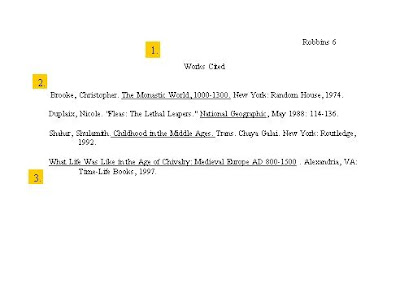
    A standard MLA paper requires a works cited list. This is the list of sources you used in your research. It is similar to a bibliography.1. Type "Works Cited" one inch from the top of your page. This measurement is pretty standard for a word processor, so you shouldn't have to make any page set-up adjustments--just start typing.
    2. Type in the information for each source, double spacing between the works. Alphabetize the works by author. If there is no author or editor mentioned, use the title (as in the last example on the list).

    3. Once you have a complete list, you will format so that you have hanging indents. To do this: highlight the list, then go to Edit and find the command for Hanging.

    MLA Image Page/Appendix Page

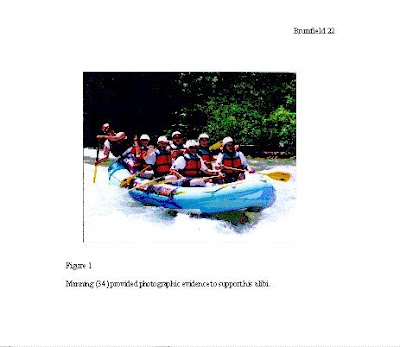
    Formatting a Page With a Figure

    MLA style guides can be confusing. This page shows you how to create a page with an image display.


    Images (figures) can make a big difference in a paper, but students are often a little hesitant about including them. This page shows you the correct format for inserting a page with a figure. Be sure to assign a number to each figure.

    Alternate First Page

    This format the alternate format for papers that contain a title page. Use This Format If Your Paper Has a Title Page


    This format the alternate format for papers that contain a title page.


    MLA papers do not typically contain a title page. If your teacher does require a title page, you should use this format for your first page.

    Double space after your title and begin your report. Notice that your last name and the page number will go at the right top corner of your page in a header.


    Go to Using Parenthetical Citations

    Title Page in MLA

    If your teacher requires a title page, you can use this sample as a guide.


    Space 9 lines down from the one-inch top margin. This will give a 2 ½ inch top margin.

    Center your persuasive MLA title 9 lines down from the top.

    Space 15 lines

    Center the word "by" centered on the page

    Double-space

    Center your name on the page

    Space 15 lines

    Center the class name and period number on the page.

    Double space

    Center your teacher's name on the page.

    Place your class information about two inches below your name.

    MLA Outline

    MLA style can be difficult to understand, but many students learn easily when they see an example. The outline follows the title page.


    The MLA outline should include the small letter "i" as a page number. This page will precede the first page of your report.

    Center your title. Below the title provide a thesis statement.

    Double space and begin your outline, according to the above sample.

    MLA Sample First Page

    A title page is not required in a standared MLA report. The title and other information go on the first page of your report.


    Begin typing on the top left of your paper. Use 12 point Times New Roman font.
    1. Place your name, your teacher's name, your class, and the date. Double space between each item.

    2. Next, double space down and type your title. Center the title.

    3. Double space below your title and begin typing your report. Indent with a tab.

    4. Remember to end your first paragraph with a thesis sentence!

    5. Your name and page number will go in a header at the top right corner of the page. You can insert this information after you type your paper. To do so in Microsoft Word, go to view and select header from the list. Type your information in the header box, highlight it, and hit the right justify selection.

    Go to Using Parenthetical Citations

    Saturday, March 17, 2007

    Interview Letter: Required for Interviews for Career Documented Essay

    Preparing Your Business Interview Letter Using the Correct Format: See pp. 298-299 in Your WRITER'S INC. Book
    PURPOSE OF THE LETTER

    Whether you do your interview (1) most desireable--live/face-to-face; (2) next most desireable--on the telephone; or (3) least desireable but acceptable--via email, this letter serves as a nice outline or script for your interview. It really makes your prepared to be successful.

    This really becomes a nice script for the interview if you do it face-to-face or on the telephone. If you are forced to do your interview via email, this can be cut and pasted into the email.

    These must be approved, revised and graded prior to actually using them.

    FORMAT OF THE LETTER
    The letter should be centered from top to bottom.
    1" or 1.5" margins should be used for the letter.
    The letter should be in Times New Roman 12 pt. font

    Part I--Date: Insert Today's Date
    March 15, 2oo7

    Part II--Sender's Address, that's your address
    DO NOT INCLUDE YOUR NAME, YOUR SIGNATURE BLOCK TAKES CARE OF THIS
    Line 1--
    Your Address or LC's Address 3504 Harry Langdon Boulevard
    Line 2--Your City, State Abbreviation (double space and Your Zip Code or Council Bluffs, IA 51503
    Line 3--Your Email Address
    Part III--Inside Address (that's the address to which you are sending the letter or the address of your interviewee)

    Part III--Inside Address, that's your address

    Line 1--Interviewee's Full Name with Title Mr. Ford, Ms. Chevrolet, Dr. Hanson, Mrs. Kreger, etc. Make sure you have a comma after the individual's name.
    Line 2--The Company, Firm that Your Interviewee Represents
    Line 3--Your Interviewee's Address
    Line 4--Your Interviewee's City, State Abbreviation (double space and Your Zip Code or Council Bluffs, IA 51503
    Line 5--Your Interviewee's Email Address

    Part IV--Salutation

    Dear Mr. Smith, Mrs. Jones or Ms. (if you do not know whether a female interviewee is married) Henderson: (colon comes right after the interviewees name)

    Part V--Body of the Letter

    Paragraph 1--
    Professionally introduce yourself, the project that we/you are working to complete (include in this the basic MPs that you are preliminarily interested in pursuing), and what you are generally looking to accomplish in the interview.
    Paragraph 2--An introduction to the questions that you have designed. Make sure that these are open-ended in nature (they require more than a word/short phrase in response). I would suggest that you begin your questions with "Could you tell me about" or "I am interested in any moral, political, ethical, economic issues that cause you or your colleagues some concern about the profession." Make sure to have eight to ten good questions.
    Paragraph 3--A request for a phone call or some other type of follow-up/contact or call to action. A sincere sentence (probably two) thanking the professional for his/her commitment to helping students learn about the career and, in turn, advancing the career.

    Part VI: Complimentary Close

    Best regards, or Sincerely, or Yours truly, (see the WRITER'S INC. BOOK for specifics here.
    Four spaces (signature goes here in black ink)
    Line 1: Your Name.
    Line 2: Lewis Central High School English 10 Student

    Part VI: Enclosures:/Copies to:/CC:

    If you are enclosing any piece(s) with the letter, give the piece(s) a title and list it/them after the colon.

    Thursday, March 15, 2007

    Pre-Speaking or Pre-Writing Block General Purpose, Specific Purpose, Audience Analysis Statement

    FOR YOUR CONVENIENCE THE INFORMATION ASSOCIATED IN THIS BLOG ENTRY IS AVAILABLE BY CLICKING ON THE FOLLOWING LINK LISTED BELOW. ONCE YOU HIT THE LINK, YOU CAN EASILY PRINT THIS INFORMATION FOR YOUR USE:

    http://docs.google.com/View?docid=dmg4wrs_14dw7fg9

    The Pre-speaking Block:
    Complete Before You Begin Constructing Your Message/Speech
    Whenever we communicate—whether it be through speaking or writing--we do so in real time for a real purpose and for a real audience. Prior to this communication, we need to consider our purpose and that audience. This pre-speaking/prewriting block is intended to assist us in developing and constructing a strong message.

    The Prespeaking Block is intended to help you focus what content and how the content should be arranged for your speeches. As a result, you know how to build your speech once you've considered these important elements.

    GENERAL PURPOSE: to+_________________
    (one word)

    (possible examples: to inform, to persuade, to convince, to teach, to introduce, to demonstrate, to motivate, to inspire)

    SPECIFIC PURPOSE: I will ______________ you that
    (gp)
    _________________________________________________ SO THAT THE
    (subject and opinion of subject=thesis base)

    AUDIENCE WILL______________________________________________.
    (desired audience action or thought=actuation)

    I will convince (GP verb) the audience that year round school is a bad idea (thesis base) so that the audience will attend the next school board meeting and help me oppose the idea and sign my petition against it (actuation).
    I will motivate (GP verb) the audience to purchase the amazing and inexpensive new Zingmaster 3000 (thesis base) so that the audience will buy one or consider buying one (actuation).
    I will inform (GP verb) the audience that school pride at Lewis Central needs to be improved (thesis base) so that the audience will show more school spirit at all school events (actuation).
    I will inspire (GP verb) the audience to spend their extra time in the worthwhile activity of volunteerism (thesis base) so that the audience will look for a worthwhile charitable organization to donate his/her time (acutation).
    AUDIENCE ANALYSIS STATEMENT: Several (at least three) sentences that analyze your audience and predict your success or failure in accomplishing your goal. Predict what the audience thinks of the subject and how they will react to the speech and/or your opinion of the speech.

    (1) What does this audience think of this topic;
    (2) How will the audience react to the information in my speech;
    (3) How is it that I will accomplish my GP & my SP
    (4) What might get in the way of me accomplishing my goals;
    (5) What prejudices, biases, filters or previous experiences might get in the way of the audience agreeing with me.
    I believe that this audience believes that school spirit is pretty good at Lewis Central High School. However, when I share examples with them that demonstrate the behaviors of students at LC during concerts, plays and some athletic events that they will understand that they should support the students who try to represent our school with pride. Some students who show great school spirit can find some value in this speech by having an influence on their friends. Students who are unattached to our school in terms of competitions, performances and pep rallies need to understand that these activities are a positive reflection on all of us. Hopefully, after hearing about the time and commitment that their fellow students demonstrate in these activities they will be inspired to demonstrate more school spirit.
    I believe that this audience believes that year-round school is a bad idea because they really don't understand the idea. By informing students that year round school actually has as many days off as our current calendar, students might reconsider their opinion. I also think that the research that I share with them will prove to them that year-round school will improve their learning, their skills and make them more competitivie for scholarships, boost their ACT scores and improve retention The major prejudice that students have with this topic is that they enjoy the long break at summer. However, several breaks during the school year will be really appealing to some of them. Getting them to reconsider their opinion on this topic is really what I'm out to achieve.

    THESIS STATEMENT:

    This (morning, afternoon, evening) I will _______________ you that
    general purpose

    ______________________________________________by _________________-ing
    subject & opinion of subject (keep it short—bumper sticker”ish”)

    (1)__________________________________;
    (2)__________________________________;
    (3)__________________________________;
    (4)__________________________________.
    preview of your main points—mini subject and opinion

    Monday, February 19, 2007

    English 10B Vocabulary: Unit 1 SAT/ACT Words

    1.1 ALOOF (uh LOOF) distant, reserved in manner; uninvolved
    Memory Link: Snowball, the cat, was so ALOOF when guests came she hid on the ROOF.

    Most everyone thought Theodore ALOOF when actually he was only very shy.

    Nothing ruins a fine dinner at a good restaurant like an ALOOF waiter who makes the entire experience uncomfortable.

    At the wedding reception, the bride's relatives were very ALOOF, hardly speaking to the groom's guests and family.


    1.2 AUSTERE (aw STEER) stern, as in manner; without excess, unadorned, severly simple and plain
    Memory Link: An AUSTERE STEER is no fun at a party.

    Jill's father was AUSTERE, rarely smiled and was always stern with her about having dates with boys he didn't know.

    The AUSTERITY of life in the village was understandable. Many were jobless and evidence of poverty was everywhere.

    Her home was AUSTERELY decorated, very plain furniture without frills and only items that were necessary.


    1.3 BULWARK (BULL wurk) a defensive wall; something serving as a principle defense.
    Memory Link: BULLS WORK building a BULWARK.


    Quebec City is the only city in North America with a BULWARK built entirely around it.

    The budget for national defense is an economic burden for all taxpayers, but we must never forget our armed services are the BULLWARK of defense for the nation.

    Our mother was a BULWARK against bad times; no matter how bad things became, she always wore a smile and had a cheerful word.

    1.4 CACOPHONY (kuh KAFH uh uee) harsh sounds
    Memory Link: A CACOPHONY of COUGHING.

    A CACOPHONY isn't noise alone, it is disturbing noise such as when people shout all at once.

    Gene thinks all rock music is a CACOPHONY to be avoided whenever possible.

    An unpleasant CACOPHONY of sound was produced as the orchestra tuned their instruments. But once they began to play together the sounds become euphonious.


    1.5 CEREBRAL (suh REE brul) of or relating to the brain; an intellectual person
    Memory Link: Eat your CEREAL so you'll grow up and be CEREBRAL like your father.

    CEREBRAL for a football player, the wily Kansas quarterback rarely called a play that wasn't well planned and thought out.

    Dr.Clark was too CEREBRAL to be a boy scout leader. Instead of saying "pitch your tents over by the cliff," he would confuse everyone with his big words and say, "construct the canvas shelters in the proximity of the promontory.


    1.6 CONNOISSEUR (kahn uh sur) an expert, particularly in matters of art and taste.
    Memory Link: The KING OF the SEWER is a CONNOISSEUR of garbage.


    My uncle is a CONNOISSEUR of fine wines.

    Art dealer, Jorge Guizar, is a CONNOISSEUR of Mexican art of the 19th century.

    When it came to coins, Jerry proclaimed he was a CONNOISSEUR, because he had collected them all his life.


    1.7 FORBEAR (for BAYR) to refrain from; to abstain; to be patient or tolerant
    Memory Link: Please FORBEAER feeding the FOR BEARS.


    To FORBEAR your opinion on any controversia matter until yyou have first heard all the facts is generally the wisest course of action.

    Jonathan said his motto was to never FORBEAR a good party for another time when you can have one today.

    Henry FORBORE his decision to close the store, deciding to wait until after the Christmas season.


    1.8 INCONGRUOUS (in KAHN grew us) not appropriate, unsuited to the surroundings; not fitting in
    Memory Link: The new Alaskkan senator's presence IN CONGRESS was INCONGRUOUS.

    Ed appeared INCONGRUOUS wearing his tuxedo on an old-fashioned hayride.

    The INCONGRUITY with Joseph's chosen career was that he had a Ph.D. in chemistry, but preferred to work as a mullet fisherman.

    INCONGRUOUSLY, Dianne spent several days a week at the library, even though she professed that she didn't like to read.

    1.9 LAMENT (la MINT) to express sorrow or regret; to mourn
    Memory Link: We LAMENT that Joe got buried in CEMENT.


    The song, "Cowboy's LAMENT," is a ballad about the lonely life of those who drive cattle for a living.

    The nation LAMENTS the passing of the President while at the same time celebrating his achievements while in office.

    It is LAMENTABLE that Rosecoe quit college in his sophomore year; his professors considered him the brightest engineering student in his class.


    1.10 LANGUISH (LANG gwish) to become weak or feeble; sag with loss of strength
    Memory Link: A FISH on LAND will quickly LANGUISH.


    An outdoorsman all his life, Mr. Franklin quickly LANGUISHED in his job as a night watchman.

    It was so hot in the theater, Charlotte soon began to LANGUISH.

    (To LANGUISH is to be LANGUID.) The fish in the aquarium hardly stirred, moving LANGUIDLY when they moved at all.