Shakespeare's Julius Caesar Study Guide
Discussion Questions
Directions: After reading each act out loud in class, the following questions will be discussed/answered in small groups in class. Each student must write the answers to the following questions in complete sentences on a separate sheet of paper. All answers should be numbered and headed with the proper act and scene numbers! Most responses will require several sentences in order to be answered completely. Be sure to rephrase the question in your answer.
Act I, Scene 1
1. What is the situation at the beginning of the play?
2. Identify Flavius and Marullus. What are they doing?
3. What is Lupercal?
Act I, Scene 2
4. What warning is given to Caesar? By whom? How does he react?
5. What are the two incidents Cassius tells to Brutus? What is his purpose in telling them?
6. What kind of person does Brutus seem to be? Cassius?
7. What is Caesar's opinion of Antony? of Cassius?
8. What is the report given by Casca?
9. How does Cassius feel about his talk with Brutus?
Act I, Scene 3
10. What is the effect of the storm? It's purpose?11. How does Cassius say he can escape tyranny?12. What is the next step in convincing Brutus?
Act II, Scene 1
1. Explain Brutus' speech that begins: “It must be by his death…”
2. Why do the conspirators want Cicero and then leave him out?
3. Why won't Brutus take an oath?
4. Why does he oppose the assassination of Antony?
5. How has Caesar changed?6. What are some of Portia's characteristics?
Act II, Scene 2
7. Describe the night.
8. What has Caesar decided to do when Decius comes? What reason does he give?
9. Why does he change his mind?
10. What are the two interpretations of the dream?
Act III, Scene 1
1. What was each of the following characters to do at the capitol: Trebonious, Cimber, Casca, Brutus?
2. How do the conspirators react to the assassination?
3. How can you prove the dream was fulfilled?
4. What prophecy is made?
5. What message does Antony's servant bring?
6. What does Antony ask of the conspirators if they plan to kill him?
7. Of what do they assure him?
8. Who doubts the wisdom of answering Antony's request?
9. Summarize Antony’s soliloquy.
Act III, Scene 2
10. How does Brutus justify Caesar's murder when he speaks to the people?
11. How is the point proven to the people?
12. How does Antony arouse the people to mutiny?
13. How does Antony show he understands the people better than Brutus?
14. What three examples does Antony give to prove that Caesar was not ambitious?
15. What are the provisions of Caesar's will?
16. Who is prepared to take control of the government of Rome now?
Act IV, Scene 1
1. What is the Second Triumvirate? Who composes it?
2. What is the new triumvirate planning to do?
Act IV, Scene 2
3. Where are Brutus and Cassius?
Act IV, Scene 3
4. Who quarrels? Why?
5. What does Brutus think of himself?
6. Why does Cassius say he is aweary of the world?
7. What alibi does Cassius use?
8. What news do we hear of Portia? What is Brutus' reaction?
9. Give the arguments pro and con for marching to Philippi. Why does Cassius think the army should be held at Sardis? Why does Brutus think they should march?
10. Why does Caesar's ghost appear to Brutus? What does it say to Brutus?
Act V, Scene 1
1. Where does the scene take place?
2. What do Brutus and Cassius do?
Act V, Scene 3
3. How does Cassius die?
4. How does Pindarus earn his freedom?
5. What happens to Titinius?
Act V, Scene 4
6. How does Brutus die?
7. What do Antony and Octavius say about Brutus?
8. Who wins and becomes ruler of Rome?
Thursday, May 14, 2009
Friday, May 1, 2009
In-Text Citations
MLA Parenthetical Citation Formats
The following are a few examples of parenthetical citation formats. For more detailed information, consult the MLA Handbook (6th edition) located on our bookshelves at 808.02 GIB. Please note: When using online resources, page numbers are omitted from the parenthetical citation.
*When you omit the author’s name in your sentence:
One research has found that dreams move backward in time as the night progresses (Dement 71).
*When you mention the author’s name in your sentence:
Freud states that “a dream is the fulfillment of a wish” (154).
When you use a website and mention the author’s name, OMIT the page number:
Smith states that “we are all individuals, similar but different.”
*When you cite more than one work by the same author:
One current theory emphasizes the principle that dreams express “profound aspects of personality” (Foulkes, “Sleep” 184). But investigation shows that young children’s dreams are “rather simple and unemotional” (Foulkes, “Dreams” 78).
*When the work has two or three authors:
Psychologists hold that no two children are alike (Gesell and Ilg 68).
*When the work has more than three authors:
(Rosenberg et al. 14)
*When the work has no author, begin with the word by which the title is alphabetized in the Works Cited:
Random testing for use of steroids by athletes is facing strong opposition by owners of several of
these teams (“Steroids” 22).
*When you quote or paraphrase a quotation from a book or article that appeared somewhere else:
Bacon observed that “it is hardly possible at once to admire an author and to go beyond him” (qtd. in Guibroy 113).
*When you cite a personal interview:
“Drinking milk made me a better person,” stated the artist (Vanilli). (Note: If you mention the name of your interview subject in your text, no parenthetical citation is necessary.)
*When you are citing several sources for a single passage:
There are negative implications to computerizing commercial art (Parker 2; “Art Nonsense” 43).
When you cite a character in a literary work:
Chai explains, “I reached out and smoothed out the frown lines on his forehead” (Pan 105).
When you cite a long quotation (five lines or more) that is set off from the text (Note that the quote is indented, double spaced, and without quotation marks):
No one is really certain about the origins of the term “Dust Bowl”:
H.L. Mencken in a footnote to the first supplement (1945) to his
monumental The American Language traces the term...to an Associated
Press dispatch sent by staff writer Robert Geiger on April 15, 1935. (French 3)
*When you paraphrase a whole passage or several passages, begin your citation with the author’s or article’s name and end it with the page number:
According to Brown, everytime you read an essay, you are preparing to write one. Therefore, you should pay careful attention to content and form (9).
When quoting from a website, use author (same format as print citation) or, if no author, title. Include page number, if given.
To identify the source of a quotation, paraphrase, or summary, place the author's last name in parentheses after the cited material (Harnack and Kleppinger). b Web pages number in the billions! (SearchQuest).
*These examples have been borrowed from Chico High School Library (CA) and the Purdue University On-Line Writing Lab.


Julius Caesar Characters: Keeping Them Straight
Julius Caesar Characters guide studies each character's role and motivation in this play.
Julius Caesar: The victorious leader of Rome, it is the fear that he may become King and revoke the privileges of men like Cassius that leads to his death at the hands of Cassius, Brutus and their fellow conspirators.
The threat that Caesar was moving away from the ideals of the Roman republic towards an Empire ruled directly by himself is the chief reason so many senators, aristocrats and even
Caesar's friend Brutus, conspired to kill him.
Introduced early in the play as a great (and arguably arrogant) leader who fears nothing, Caesar is warned by Artemidorus, The Soothsayer and wife (Calphurnia) alike not to go to the Senate on the "ides of March" the very day he is assassinated.
Caesar later returns in the play as a ghost which haunts Brutus in Act V. Easily flattered by Decius Brutus (not to be confused with Brutus), Caesar appears to us as a man almost guided not so much by his own will but what he believes are the expectations his people have of "Caesar." This is why he is reluctant to show fear, Caesar, as he frequently refers to himself in the third person, fears nothing and can show no sign of weakness or indeed mortality...
Note: The "ides of March" is the fifteenth of March (See Act II, Scene I, Line 58).
Octavius Caesar: The adopted son of Caesar, Octavius by history, ultimately became ruler of the Roman Empire following his defeat of Mark Antony in Egypt (See Shakespeare's Antony and Cleopatra). In this play, Octavius with Mark Antony and Lepidus (The Second Triumvirate), destroy the forces of Brutus and Cassius on the Plains of Philippi, which results in the death of both these conspirators (Act V).
Marcus Antonius (Mark Antony): One of the Triumvirs (leaders) who rule Rome following Caesar's assassination. Mark Antony (Marcus Antonius) is famous in this play for his speech, which turns the Romans against Brutus following his group's assassination of Caesar. Famous for the immortal lines "Friends, Romans, countrymen, lend me your ears;" (Act III, Scene II, Line 79), Mark Antony with fellow Triumvirs, Octavius and Lepidus later defeat Brutus and Cassius on the Plains of Philippi in Act V.
M. Aemilius Lepidus: The last of the Triumvirs, this old man holds little real power and is used in Mark Antony's own words as a loyal, trusted man "Meet [fit] to be sent on errands:" (Act IV, Scene I, Line 13).
Cicero: A well-known orator (public speaker) and Senator, Cicero is killed by the Triumvirs (Mark Antony, Octavius and Lepidus) following Caesar's assassination.
Publius: A Senator who travels with Caesar to the Senate House the day Caesar is killed, he witnesses Caesar's assassination. Though deeply "confounded" or confused and shaken by the assassination of Caesar (Act III, Scene I, Line 86), he is used by Brutus to tell the citizens of Rome that Caesar aside, no one else will be hurt (Act III, Scene I, Lines 89-91).
Popilius Lena: The Senator who terrifies Cassius by telling Cassius that he hopes his "enterprise [assassination attempt] today may thrive" or be successful just as Caesar goes into the Senate house on the "ides of March" (Act III, Scene I, Line 13).
Marcus Brutus: The most complex character in this play, Brutus is one of the men who assassinate Caesar in the Senate. Brutus is complex, because he does not kill Caesar for greed, envy nor to preserve his social position like so many of the other conspirators against Caesar. This Brutus makes very clear in his speech in Act III, Scene II (Lines 12-76), when he explains his actions as being for the good of Rome.
Unlike the other conspirators, Brutus is in fact a dear friend of Caesar's but kills his beloved friend not for who he is, but what he could become as a King. It is for this reason that when Brutus dies by suicide in Act V, Mark Antony describes his bitter enemy by saying "This [Brutus] was the noblest Roman of them all;" (Act V, Scene V, Line 68).
Mark Antony recognizes with these words that Brutus acted from a sense of civic duty, not malice, nor greed nor envy.
In academic circles, Brutus is still a source of much heated debate; does assassinating a leader for the good of the people constitute bravery worthy of a tragic hero or can the end never justify the means? The controversy on whether Brutus is tragic hero or villain still rages...
Ironically, though it can be argued that Brutus assassinated his friend to prevent one man ruling the Roman Empire, history was later to make this a reality. Octavius, one of the Triumvirs who defeated Brutus and Cassius, was later to become a Roman Emperor ruling the entire Roman Empire alone following his victory over Cleopatra and Mark Antony.
Cassius: One of the original conspirators against Caesar. Like the other conspirators he fears what life under King Caesar's rule could mean for him and the privileges he has.
Unlike the other conspirators however, Cassius plays a leading role in Caesar's assassination. It is he who gathers those against Caesar around him and it is Cassius who carefully manipulates Brutus to their cause by appealing to Brutus' sense of civic duty which believes that Caesar as a King would be bad for the people of Rome and by Cassius' clever use of forged letters.
The great thinker of the conspiracy, his advice is continually overruled by Brutus with tragic results for the conspirators.
First, his advice to kill Mark Antony as well as Caesar is ignored leading to Mark Antony becoming their greatest enemy.
Later at Caesar's funeral, Cassius' advice that Mark Antony should not speak at the funeral is also ignored leading to Antony turning the masses against the previously popular conspirators.
Finally in Act V, Brutus ignores Cassius' advise to stay on high ground, leading to a battle in the plains of Philippi, a battle favored by Mark Antony and Octavius, their enemies. Like Brutus, he dies by suicide in Act V, when fearing Brutus dead, he commits suicide.
Casca: One of the conspirators against Caesar, he starts the actual assassination of Caesar by stabbing first from behind.
Terminus: The only conspirator who does not actually stab Caesar, he is the man responsible for saving Mark Antony's life following Caesar's assassination. He leads Mark Antony away from the Senate house following the assassination and he backs up Brutus' suggestion that Mark Antony's life be spared.
Ligarius: The reluctant assassin, Caius Ligarius at first hesitates in killing Caesar, but later enthusiastically follows the others in killing Caesar after Brutus restores his conviction.
Decius Brutus: A man who lures Caesar to his death by his deep understanding of Caesar's true vanity...
Not to be confused with Marcus Brutus, who is referred to in Julius Caesar simply as as Brutus. It is Decius Brutus who convinces Caesar to turn up to the Senate on the "ides of March" after Caesar announces that he is unwilling to attend the day's Senate because of his wife Calphurnia's dream foretelling doom. Decius Brutus turns Calphurnia's dream into a reason to attend the Senate by cleverly reinterpreting its negative imagery to instead symbolize Caesar's triumph.
Metellus Cimber: A conspirator against Caesar, it is his petition or request to Caesar for his brother's banishment to be overturned, that allows the conspirators to move close to Caesar, before they assassinate him with multiple stab wounds...
Cinna: A conspirator against Caesar, who plays a key role in enlisting Brutus to their cause. It is Cinna who suggests to Cassius that Brutus join their conspiracy. Also assists Cassius' manipulation of Brutus by placing Cassius' letters responsible for manipulating Brutus where Brutus is sure to find and read them... Indirectly responsible for Cinna, the poet's death; since it is he the mob originally wished to kill...
Flavius and Marullus: Two Tribunes introduced to us at the beginning of the play. Their conversation reveals the deep mistrust and fear many in Rome have about Caesar's growing popularity, which eventually leads to Caesar's assassination. These two men criticize Rome's citizens for praising Caesar almost without reason and are later put to death or "put to silence" for "pulling scarfs off Caesar's images," (Act I, Scene II, Line 291) during the Feast of Lupercal in Act I, Scene I (Note: Flavius the Tribune is not the same person as Flavius, a soldier whom appears in Act IV).
Artemidorus: The man who nearly saves Caesar, he presents Caesar with a letter warning warning Caesar that he will be killed (Act II, Scene III). Caesar however does not read the letter and so proceeds to his doom...
Cinna, the Poet: A humble poet, this man dies because he has the wrong name at the wrong time. After Mark Antony incites (angers) the people of Rome against Caesar's assassins, Cinna who shares the same name as one of the assassins, is killed despite his explaining his identity as a poet. The mob, eager for blood, kill him regardless and use the excuse that they never liked his poems much anyway (Act III, Scene III, Lines 1-43).
Lucilius, Titinius, Messala, Young Cato and Volumnius: Friends to Brutus and Cassius.
Varro, Clitus, Claudius, Strato, Lucius and Dardanius: Servants to Brutus.
Pindarus: A servant to Cassius, he is also the messenger bearing the wrong news... In Act V, Pindarus misreports to Cassius that Titinius, a scout sent to Brutus' forces was captured by the Triumvir's forces when he was actually welcomed by Brutus' army. On Pindarus' information, Cassius assumes that Brutus has been defeated and so thinking all is lost, decides to kill himself, using Pindarus to hold a sword out which he runs onto, the very sword, Cassius used against Caesar...
Calphurnia: The wife of Caesar, she begs her husband not to go to the Senate on "the ides of March" (March 15) when she cries out "'Help, ho! They murder Caesar!'" three times in her sleep, the day before Caesar's death. This and strange occurrences such as a lioness whelping in the streets of Rome,"Fierce fiery warriors" fighting in the clouds (Act II, Scene II, Lines 12-24) and graves yawning and yielding up their dead, convince Calphurnia that her husband Julius Caesar, must stay home on the "ides of March" (the fifteenth of March). Unfortunately just as Calpurnia convinces Caesar to stay home and avoid the death that awaits him, Decius Brutus (not to be confused with Brutus), arrives at Caesar's home convincing him that these images mean that Rome will be revived by Caesar's presence at the Senate the following day. Caesar ignores his wife's pleas and meets his bloody destiny at the hands of Brutus and company the very next day.
Portia: The wife of Marcus Brutus, she tries to learn from Brutus the assassination conspiracy he is hiding from her. She is later assumed to have committed suicide at the end of the play when her death is reported as being under strange circumstances...
Senators, Citizens, Guards, Attendants and others...
Julius Caesar Quotes? Who Said It?, What Makes it Important?
 A Shakespearean quote such as "To be, or not to be" and the famous "O Romeo, Romeo! wherefore art thou Romeo?" quote form some of literature's most celebrated lines and if asked to recite one of Shakespeare's most famous quotations the majority of people would choose one of these. However, many expressions that we use every day originated in Shakespeare's plays. We use the Bard's words all of the time in everyday speech, however, we are often totally unaware that we are 'borrowing' sayings from his work - we frequently quote Shakespeare! Will Shake-speare is attributed with writing 38 plays, 154 sonnets and 5 other poems and used about 21,000 different words. Shake-speare is credited by the Oxford English Dictionary with the introduction of nearly 3,000 words into the language. It's no wonder that expressions from his works are an 'anonymous' part of the English language.
"Friends, Romans, countrymen, lend me your ears; I come to bury Caesar, not to praise him". Quote (Act III, Scene II).
"But, for my own part, it was Greek to me". - Julius Caesar Quote (Act I, Scene II).
"A dish fit for the gods". Quote (Act II, Scene I).
"Cry "Havoc," and let slip the dogs of war". Julius Caesar Quote (Act III, Sc. I).
"Et tu, Brute!" Quote (Act III, Scene I).
"Men at some time are masters of their fates: The fault, dear Brutus, is not in our stars, but in ourselves, that we are underlings". - (Quote Act I, Scene II).
"Not that I loved Caesar less, but that I loved Rome more". Quote (Act III, Scene II).
"Beware the ides of March". - (Quote Act I, Scene II).
"This was the noblest Roman of them all". - (Quote Act V, Sc. V).
"When that the poor have cried, Caesar hath wept: Ambition should be made of sterner stuff". - (Quote Act III, Sc. II).
"Yond Cassius has a lean and hungry look; He thinks too much: such men are dangerous" Julius Quote (Act I, Scene II).
"For Brutus is an honourable man; So are they all, all honourable men". - (Quote Act III, Sc. II).
"As he was valiant, I honour him; but, as he was ambitious, I slew him" . Quote (Act III, Sc. II).
"Cowards die many times before their deaths; The valiant never taste of death but once.Of all the wonders that I yet have heard, it seems to me most strange that men should fear;Seeing that death, a necessary end, will come when it will come". Julius Caesar Quote (Act II, Scene II).
Making In-Text or Parenthetical Citations
Many high school teachers will require students to use MLA Style for their papers. You should check with the instructor for information about line spacing, margins, and a title page, since teachers may have their own preferences.
Your teacher will probably provide a style guide of some sort to address these parts of the paper.
As you write your paper in MLA style, you will be talking about things you found in your research. Therefore, you will have to indicate in your text exactly where you found the information.
This can be done with parenthetical citations.
When you make reference to someone else's idea, either through paraphrasing or quoting them directly, you provide the author’s name and the page number of the work in the text of your paper.
This is the parenthetical citation, and it is the alternative to using footnotes (like you will do if you use other styles found elsewhere on this site).
Here is an example of parenthetical citations:
Even today, many children are born outside the safety of hospitals (Kasserman 182).
This indicates that you are using information found in a book by somebody named Kasserman (last name) and it was found on page 182.
You may also give the same information in another way, if you want to name the author in your sentence. You might want to do this to add variety to your paper:
According to Laura Kasserman, “many children today do not benefit from the sanitary conditions which are available in modern facilities” (182). Many children are born outside the safety of hospitals.
Be sure to use quotation marks when quoting someone directly.
MLA Bibliography Tutorial and Guide
Suggested Reading
Electronic SourceWriting a Research PaperUsing a Library
Related Articles
Books About MLA Style
Thursday, April 30, 2009
Julius Caesar: Historical Background
Shakespeare's Julius Caesar Study Guide
Background Information
Setting
Ancient Rome 44 B.C.
The play takes place before Rome developed into an empire. Julius Caesar has just defeated Pompey after a long civil war. He returns to Rome triumphantly and is in a position to take power. Some people are concerned because dictators have taken power before.
Julius Caesar, was a Roman military and political leader and one of the most influential men in world history. He played a critical role in the transformation of the Roman Republic into the Roman Empire. His conquest of Gaul extended the Roman world all the way to the Atlantic Ocean, and he was also responsible for the first Roman invasion of Britain in 55 BC.
Leading his legions across Rubicon, Caesar sparked civil war in 49 BC that left him the undisputed master of the Roman world. After assuming control of the government, he began extensive reforms of Roman society and government. He was proclaimed dictator for life, and he heavily centralized the bureaucracy of the Republic. This forced the hand of a friend of Caesar, Marcus Junius Brutus, who then conspired with others to murder the dictator and restore the Republic. This dramatic assassination occurred on the Ides of March (March 15th) in 44 BC and led to another Roman civil war. In 42 BC, two years after his assassination, the Roman Senate officially sanctified him as one of the Roman deities.
Caesar's military campaigns are known in detail from his own written Commentaries (Commentarii), and many details of his life are recorded by later historians, such as Appian, Suetonius, Plutarch, Cassius Dio and Strabo. Other information can be gleaned from other contemporary sources, such as the letters and speeches of Caesar's political rival Cicero, the poetry of Catullus and the writings of the historian Sallust.
BRUTUS
Marcus Junius Brutus (85 BC – 42 BC), or Quintus Servilius Caepio Brutus, was a Roman senator of the late Roman Republic. Though in popular culture, it is believed that Brutus was the sole assasin of Julius Caesar, historically he was not alone in the dictator's assasination conspiracy, but was among possibly up to sixty men.
Other Brutus Links
1 Life
2 Chronology
3 Brutus in popular culture
3.1 Influence
3.2 Fiction
3.3 Drama
4 Family tree
5 Notes
6 External links
Drama
In Shakespeare's play Julius Caesar, actors such as James Mason, Jason Robards and Richard Pasco have played the role of Marcus Brutus in television productions and films.
In Julius Caesar he is portrayed by Ian Duncan.
A fictionalised Marcus Junius Brutus appears in the 2005 television series Rome, played by
Tobias Menzies.
Marcus Brutus also appears in the highly fictionalised 2005 six-part mini series Empire played by James Frain.
Characters
Another Look at Key Characters
Julius Caesar
Although Caesar was one of the strongest individuals in history, Shakespeare presents him with a number of weaknesses. In spite of all of these weaknesses, it is the spirit of Caesar that pervades the whole play. At the end of the play, Brutus says, "Caesar, thou art mighty yet."
Brutus
Brutus is the epitome of all that is gentle and good in man. His sterner qualities make him admirable; his gentler qualities make him lovable. He is one of the finest characters in all of Shakespeare's writing. Had Brutus been less idealistic and less merciful, he no doubt would have been successful in crushing the powerful forces of Caesar. His three mistakes cost him his life, but Brutus feels no enmity, even in death.
Cassius
If ever Shakespeare presented characters in contrast, he does it in molding the conspiracy around Cassius and Brutus. Cassius is the realist, the shrewd contriver, the ambitious one. He is the clever psychologist who knows just how to manipulate Brutus' thoughts and how to bring him into the conspiracy. Cassius is a strong leader, but he has one weakness—his admiration for Brutus. That admiration overrules his better judgment and culminates in his downfall. Without Brutus in the play, Cassius would have emerged as a much stronger leader.
Marc Antony
At the time of Caesar's assassination, Antony was thirty-seven years old. Never taking life very seriously, he led a pleasure-loving existence. Because he was reckless, careless, and handsome, the people loved him. Antony proves himself to be clever when he addresses the crowd after Caesar’s murder and convinces them that Caesar was not ambitious.
Octavius
Octavius was nineteen when Caesar was assassinated and only twenty-one when he and Antony defeated the conspirators at Philippi. Eleven years later, he sent Antony and Cleopatra to defeat and death. Shakespeare wrote about that subject in his play Antony and Cleopatra. Octavius ruled Rome for forty-one years (until 17 A.D.). He was called the august, the grand, the magnificent (Augustus).
Background Information
Setting
Ancient Rome 44 B.C.
The play takes place before Rome developed into an empire. Julius Caesar has just defeated Pompey after a long civil war. He returns to Rome triumphantly and is in a position to take power. Some people are concerned because dictators have taken power before.
Julius Caesar, was a Roman military and political leader and one of the most influential men in world history. He played a critical role in the transformation of the Roman Republic into the Roman Empire. His conquest of Gaul extended the Roman world all the way to the Atlantic Ocean, and he was also responsible for the first Roman invasion of Britain in 55 BC.
Leading his legions across Rubicon, Caesar sparked civil war in 49 BC that left him the undisputed master of the Roman world. After assuming control of the government, he began extensive reforms of Roman society and government. He was proclaimed dictator for life, and he heavily centralized the bureaucracy of the Republic. This forced the hand of a friend of Caesar, Marcus Junius Brutus, who then conspired with others to murder the dictator and restore the Republic. This dramatic assassination occurred on the Ides of March (March 15th) in 44 BC and led to another Roman civil war. In 42 BC, two years after his assassination, the Roman Senate officially sanctified him as one of the Roman deities.
Caesar's military campaigns are known in detail from his own written Commentaries (Commentarii), and many details of his life are recorded by later historians, such as Appian, Suetonius, Plutarch, Cassius Dio and Strabo. Other information can be gleaned from other contemporary sources, such as the letters and speeches of Caesar's political rival Cicero, the poetry of Catullus and the writings of the historian Sallust.
BRUTUS
Marcus Junius Brutus (85 BC – 42 BC), or Quintus Servilius Caepio Brutus, was a Roman senator of the late Roman Republic. Though in popular culture, it is believed that Brutus was the sole assasin of Julius Caesar, historically he was not alone in the dictator's assasination conspiracy, but was among possibly up to sixty men.
Other Brutus Links
1 Life
2 Chronology
3 Brutus in popular culture
3.1 Influence
3.2 Fiction
3.3 Drama
4 Family tree
5 Notes
6 External links
Drama
In Shakespeare's play Julius Caesar, actors such as James Mason, Jason Robards and Richard Pasco have played the role of Marcus Brutus in television productions and films.
In Julius Caesar he is portrayed by Ian Duncan.
A fictionalised Marcus Junius Brutus appears in the 2005 television series Rome, played by
Tobias Menzies.
Marcus Brutus also appears in the highly fictionalised 2005 six-part mini series Empire played by James Frain.
Characters
Julius Caesar
A great Roman general who has recently returned to Rome after a military victory in Spain. Julius Caesar is not the main character of the play that bears his name; Brutus has over four times as many lines, and the play does not show us Caesar's point of view. Nonetheless, virtually every other character is preoccupied with Caesar—specifically, with the possibility that Caesar may soon become king. If Caesar were to become king, it would mean the end of Rome's republican system of government, in which senators, representing the citizens of Rome, wield most of the power. To noblemen like Brutus and Cassius, who consider themselves the equals of Caesar or any other citizen, Caesar's coronation would mean they would no longer be free men but rather slaves. Caesar never explicitly says that he wants to be king—he even refuses the crown three times in a dramatic public display—but everything he says and does demonstrates that he regards himself as special and superior to other mortals. In his own mind, he seems already to be an absolute ruler.
A great Roman general who has recently returned to Rome after a military victory in Spain. Julius Caesar is not the main character of the play that bears his name; Brutus has over four times as many lines, and the play does not show us Caesar's point of view. Nonetheless, virtually every other character is preoccupied with Caesar—specifically, with the possibility that Caesar may soon become king. If Caesar were to become king, it would mean the end of Rome's republican system of government, in which senators, representing the citizens of Rome, wield most of the power. To noblemen like Brutus and Cassius, who consider themselves the equals of Caesar or any other citizen, Caesar's coronation would mean they would no longer be free men but rather slaves. Caesar never explicitly says that he wants to be king—he even refuses the crown three times in a dramatic public display—but everything he says and does demonstrates that he regards himself as special and superior to other mortals. In his own mind, he seems already to be an absolute ruler.
Brutus
A high-ranking, well-regarded Roman nobleman who participates in a conspiracy to assassinate Caesar. Brutus is motivated by his sense of honor, which requires him to place the good of Rome above his own personal interests or feelings. Thus, he plots against Caesar in order to preserve the republic even though he loves and admires Caesar personally. While the other conspirators act out of envy and rivalry, only Brutus truly believes that Caesar's death will benefit Rome. Brutus's sense of honor is also his weakness, as he tends to assume that his fellow Romans are as highminded as he is, which makes it easy for others to manipulate him.
A high-ranking, well-regarded Roman nobleman who participates in a conspiracy to assassinate Caesar. Brutus is motivated by his sense of honor, which requires him to place the good of Rome above his own personal interests or feelings. Thus, he plots against Caesar in order to preserve the republic even though he loves and admires Caesar personally. While the other conspirators act out of envy and rivalry, only Brutus truly believes that Caesar's death will benefit Rome. Brutus's sense of honor is also his weakness, as he tends to assume that his fellow Romans are as highminded as he is, which makes it easy for others to manipulate him.
Antony
A loyal friend of Caesar's. In contrast to the self-disciplined Brutus, Antony is notoriously impulsive and pleasure-seeking, passionate rather than principled. He is extremely spontaneous and lives in the present moment. As resourceful as he is unscrupulous, Antony proves to be a dangerous enemy of Brutus and the other conspirators.
A loyal friend of Caesar's. In contrast to the self-disciplined Brutus, Antony is notoriously impulsive and pleasure-seeking, passionate rather than principled. He is extremely spontaneous and lives in the present moment. As resourceful as he is unscrupulous, Antony proves to be a dangerous enemy of Brutus and the other conspirators.
Cassius
A talented general and longtime acquaintance of Caesar. Cassius resents the fact that the Roman populace has come to revere Caesar almost as a god. He slyly leads Brutus to believe that Caesar has become too powerful and must die, finally converting Brutus to his cause by sending him forged letters claiming that the Roman people support the death of Caesar. Impulsive and unscrupulous like Antony, Cassius harbors no illusions about the way the political world works. A shrewd opportunist, he acts effectively but lacks integrity.
A talented general and longtime acquaintance of Caesar. Cassius resents the fact that the Roman populace has come to revere Caesar almost as a god. He slyly leads Brutus to believe that Caesar has become too powerful and must die, finally converting Brutus to his cause by sending him forged letters claiming that the Roman people support the death of Caesar. Impulsive and unscrupulous like Antony, Cassius harbors no illusions about the way the political world works. A shrewd opportunist, he acts effectively but lacks integrity.
Octavius
Caesar's adopted son and appointed successor. Octavius, who had been traveling abroad, returns after Caesar's death, then joins with Antony and sets off to fight Cassius and Brutus. Antony tries to control Octavius's movements, but Octavius follows his adopted father's example and emerges as the authoritative figure, paving the way for his eventual seizure of the reins of Roman government.
Caesar's adopted son and appointed successor. Octavius, who had been traveling abroad, returns after Caesar's death, then joins with Antony and sets off to fight Cassius and Brutus. Antony tries to control Octavius's movements, but Octavius follows his adopted father's example and emerges as the authoritative figure, paving the way for his eventual seizure of the reins of Roman government.
Casca
One of the conspirators. Casca is a tribune (an official elected to represent the common people of Rome) who resents Caesar's ambition. A rough and blunt-speaking man, Casca relates to Cassius and Brutus how Antony offered the crown to Caesar three times and how each time Caesar declined it. Casca insists, however, that Caesar was acting, manipulating the populace into believing that he has no personal ambition. Casca is the first to stab Caesar.
One of the conspirators. Casca is a tribune (an official elected to represent the common people of Rome) who resents Caesar's ambition. A rough and blunt-speaking man, Casca relates to Cassius and Brutus how Antony offered the crown to Caesar three times and how each time Caesar declined it. Casca insists, however, that Caesar was acting, manipulating the populace into believing that he has no personal ambition. Casca is the first to stab Caesar.
Calphurnia
Caesar's wife. Calphurnia invests great authority in omens and portents. She warns Caesar against going to the Senate on the Ides of March, for she has had terrible nightmares and heard reports of many bad omens.
Caesar's wife. Calphurnia invests great authority in omens and portents. She warns Caesar against going to the Senate on the Ides of March, for she has had terrible nightmares and heard reports of many bad omens.
Portia
Brutus's wife and the daughter of a noble Roman (Cato) who took sides against Caesar. Portia, accustomed to being Brutus's confidante, is upset to find him so reluctant to speak his mind when she finds him troubled.
Brutus's wife and the daughter of a noble Roman (Cato) who took sides against Caesar. Portia, accustomed to being Brutus's confidante, is upset to find him so reluctant to speak his mind when she finds him troubled.
Flavius and Murellus
Two tribunes who condemn the plebeians for their fickleness in cheering Caesar when once they cheered for Caesar's enemy Pompey. Flavius and Murellus are punished for removing the decorations from Caesar's statues during Caesar's triumphal parade.
Two tribunes who condemn the plebeians for their fickleness in cheering Caesar when once they cheered for Caesar's enemy Pompey. Flavius and Murellus are punished for removing the decorations from Caesar's statues during Caesar's triumphal parade.
Cicero
A Roman senator renowned for his oratorical skill. Cicero speaks at Caesar's triumphal parade. He later dies at the order of Antony, Octavius, and Lepidus.
A Roman senator renowned for his oratorical skill. Cicero speaks at Caesar's triumphal parade. He later dies at the order of Antony, Octavius, and Lepidus.
Lepidus
The third member of Antony and Octavius's coalition. Though Antony has a low opinion of Lepidus, Octavius trusts Lepidus's loyalty.
The third member of Antony and Octavius's coalition. Though Antony has a low opinion of Lepidus, Octavius trusts Lepidus's loyalty.
Decius
A member of the conspiracy. Decius convinces Caesar that Calphurnia misinterpreted her dire nightmares and that, in fact, no danger awaits him at the Senate. Decius leads Caesar right into the hands of the conspirators.
A member of the conspiracy. Decius convinces Caesar that Calphurnia misinterpreted her dire nightmares and that, in fact, no danger awaits him at the Senate. Decius leads Caesar right into the hands of the conspirators.
Another Look at Key Characters
Julius Caesar
Although Caesar was one of the strongest individuals in history, Shakespeare presents him with a number of weaknesses. In spite of all of these weaknesses, it is the spirit of Caesar that pervades the whole play. At the end of the play, Brutus says, "Caesar, thou art mighty yet."
Brutus
Brutus is the epitome of all that is gentle and good in man. His sterner qualities make him admirable; his gentler qualities make him lovable. He is one of the finest characters in all of Shakespeare's writing. Had Brutus been less idealistic and less merciful, he no doubt would have been successful in crushing the powerful forces of Caesar. His three mistakes cost him his life, but Brutus feels no enmity, even in death.
Cassius
If ever Shakespeare presented characters in contrast, he does it in molding the conspiracy around Cassius and Brutus. Cassius is the realist, the shrewd contriver, the ambitious one. He is the clever psychologist who knows just how to manipulate Brutus' thoughts and how to bring him into the conspiracy. Cassius is a strong leader, but he has one weakness—his admiration for Brutus. That admiration overrules his better judgment and culminates in his downfall. Without Brutus in the play, Cassius would have emerged as a much stronger leader.
Marc Antony
At the time of Caesar's assassination, Antony was thirty-seven years old. Never taking life very seriously, he led a pleasure-loving existence. Because he was reckless, careless, and handsome, the people loved him. Antony proves himself to be clever when he addresses the crowd after Caesar’s murder and convinces them that Caesar was not ambitious.
Octavius
Octavius was nineteen when Caesar was assassinated and only twenty-one when he and Antony defeated the conspirators at Philippi. Eleven years later, he sent Antony and Cleopatra to defeat and death. Shakespeare wrote about that subject in his play Antony and Cleopatra. Octavius ruled Rome for forty-one years (until 17 A.D.). He was called the august, the grand, the magnificent (Augustus).
Tuesday, April 21, 2009
English 10B Vocabulary: Unit 3 SAT/ACT Words
3.1 AMBIANCE (AM bee uns) mood, feeling; general atmosphere
Memory Link: Ambulance George did not enjoy the AMBIANCE in the AMBULANCE.
The AMBIANCE of the locker room after the team lost the championship was depressing.
For their daughter's birthday party, the Jeffersons' created an AMBIANCE of gaiety, decorating the gardent with bright balloons and ribbons.
The AMBIANCE in the Italian restaurant was delightful, there was soft music, candlelight and singing waiters.
3.2 GRANDILOQUENT (gran DIL uh kwunt) attempting to impress with big words or grand gestures
Memory Link: Grand Elephant The GRAND ELEPHANT made a GRANDILOQUENT speech.
It was another GRANDILOQUENT political affair; the candidates made the same old promises for lower taxes and more free services.
They may be eloquent, but here is nothing grand about pompous GRANDILOQUENT speakers.
The new teacher's GRANDILOQUENCE didn't fool the class one bit. She really knew very little about South American History.
3.3 GOSSAMER (GOSS uh mer) delicate floating cobwebs; a sheer gauzy fabric; something delicate, light, flimsy
Memory Link: CUSTOMER The spider's GOSSAMER captured many unhappy CUSTOMERS.
The bride wore a white silk wedding dress which touched the floor as she proceeded up the aisle to the altar. A GOSSAMER of fine Italian lace gently touched her face.
Between the audience and the actors on the stage hung a thing GOSSAMER of fabric, heightening the feeling that the actors were in a dream-like setting.
3.4 HARROWING (HARE roe ing) extremely distressed; disturbing or frightening
Memory Link: HARE ROWING A HARROWING experience for a HARE ROWING.
After the HARROWING experience when Eddies main parachute didn't open, and his emergerncy chute save him only at the last minute, he vowed never to jump again.
(HARRIED is to be troubled or bothered while HARROWING is to be frightened to the extreme.) At first we were HARRIED by the gang members and insulted, but later it became a HARROWING experience as they chased and threatened us with knives.
3.5 IRASCIBLE (i RAS uh bul) easily angered, irritable
Memory Link: WRESTLE BULLS When he became IRASCIBLE, the Masked Marvel would WRESTLE BULLS.
Normally, Rose was a pleasant wife and mother but if a member of her family prevented her from watching her favorite "soaps," she could become quite IRASCIBLE.
Uncle Tim was a real grouch, even on his birthday he would find a way to become so IRASCIBLE as a spoiled child.
The school principal became so IRASCIBLE even his teachers avoided speaking to him.
3.6 LASSITUDE (LAS uh tood) listlessness; torpor, weariness
Memory Link: LAZY DUDE A LAZY DUDE with LASSITUDE.
After eating three servints of Thanksgiving dinner, George succumbed to a feeling of LASSITUDE and fell asleep on the couch.
Having worked for the cannery for twenty years without a raise, Charles became discouraged with his employers and approached his daily work with unenthusiastic LASSITUDE.
3.7 LACONIC (luh KAHN ik) brief, using few words
Memory Link: Grandma was laconic when giving grandpa his TONIC.
3.8 MYRIAD (MIR ee ud) an extremely large number
Memory Link: The trick MIRROR ADDs a myriad of reflections.
3.9 NOXIOUS(KNOCKS ee us) physically or mentally destructive, or harmful to human beings
Memory Link: Her overdose of perfume was so noxious that it knocked us off the bench.
3.10 QUEUE (Q) to form or to wait in line
Memory Link: The "Q's" formed a Q to jump into the alphabet soup.
Monday, April 20, 2009
In-Text Citation Examples & Resources
"How To" Appropriately Use MLA In-Text Citations in a Variety of Documented Writing Situations from Your Valuable Research & Research Cards
Your research cards should contain the information that you need to handle the "in-text" citation appropriately. I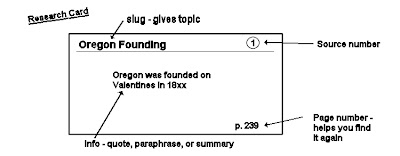 recommend that you not only provide a "slug" or "sub-headling" but--eventually--where this information will fit into your MLA Outline (i.e. II.A.1.) Notice that this sample is numbered in the right hand corner and that they page number(s) are in the bottom right hand corner. This card is a tad too thin in the amount of information that is included on it. Moreover, types of support include: direct quotations, an indirect quote, a paraphrase or a summary. Remember, though, that types of evidence include: facts, inferences, expert opinions, charts/graphs, statistics, personal experiences, interviews, and much more. I suggest that researchers include what type of evidence is being researched in the bottom right hand corner.
SAMPLE NOTECARD (ABOVE) TAKEN FROM:Denny, Rialta. "evasive4.tripod.com/notecardformat.gif." evasive4.vze.com. 13 Jan 2007.tripod.com/&h=550&w=750&sz=9&hl=en&sig2=R9Lgl_aUaYmJdkOLREQz2w&start
=2&tbnid=_Sg-Oe6fObkXNM:&tbnh=103&tbnw=141&ei=egipRYCFNJSCjAGD4pmLBg
&prev=/images%3Fq%3DMLA%2BNotecard%26svnum%3D10%26hl%3Den%26lr%3D>.
NOTE: After the first line of an MLA Work's Cited entry, the author is to indent the subsequent lines. This blog will not allow me to do so for you.
Correct Ways to Handle "In-Text" Citations
Single author named in parentheses.
Example: The tendency to come to terms with difficult experiences is referred to as a "purification process" whereby "threatening or painful dissonances are warded off to preserve intact a clear and articulated image of oneself and one’s place in the world" (Sennett 11).
Note: The punctuation here uses a direct quotation. Notice that the end quotation mark ends prior to the "in-text" citation in parentheses. Notice that there is no commo, nor an abbreviation for page number. Also notice that the parentheses are followed by the appropriate punctuation mark.
Single author or Sinlge Source named in a signal phrase.
Example: Social historian Richard Sennett names the tendency to come to terms with difficult experiences a "purification process" whereby "threatening or painful dissonances are warded off to preserve intact a clear and articulated image of oneself and one’s place in the world" (11).
Note: If you introduce the author or source in the text of your paper (and there is no duplicate in the author's name or a book with the same exact title (not likely but possible), you need only include the page number of that source and not the source itself.
Two or more authors.
Example. Certain literacy theorists have gone so far as to declare that "the most significant elements of human culture are undoubtedly channeled through words, and reside in the particular range of meanings and attitudes which members of any society attach to their verbal symbols" (Goody and Watt 323).
Corporate author (organization, association, etc.).
Example. The federal government has funded research concerning consumer protection and consumer transactions with online pharmacies (Food and Drug Administration 125).
Works with no author.
Example. Several critics of the concept of the transparent society ask if a large society would be able to handle the complete loss of privacy ("Surveillance Society" 115).
Two or more works by the same author.
Example. In his investigation of social identity, The Uses of Disorder, Sennett defines adulthood as a stage where people "learn to tolerate painful ambiguity and uncertainty" (108).
Note: The author can identify which of the two works is being referenced by signaling it in his or her writing.
In a surprising move, Richard Sennett combines the idea of power with that of virtue: "the idea of strength is complex in ordinary life because of what might be called the element of its integrity" (Authority 19).
Note: In this situation, the author signifies which of the two works is being referenced--not in the text of the writing--but by using the title of the source in the in-text citation.
Work found in an anthology or edited collection.
Note: For an essay, short story, or other document included in an anthology or edited collection, use the name of the author of the work, not the editor of the anthology or collection, but use the page numbers from the anthology or collection.
Lawrence Rosenfield analyzes the way in which New York’s Central Park held a socializing function for nineteenth-century residents similar to that of traditional republican civic oratory (222).
Bible passage.
Unfortunately, the president could not recall the truism that "Wisdom is a fountain to one who has it, but folly is the punishment of fools" (New Oxford Annotated Bible, Prov. 20-22).
Note: The author needs to include the specific Bible in the in-text citation.
Secondary source of a quotation (someone quoted within the text of another author).
As Erickson reminds us, the early psychoanalysts focused on a single objective: "introspective honesty in the service of self enlightenment" (qtd. in Weiland 42).
Note: If one author is quoted by another, this is the appropriate way to handle it.
Web page.
Abraham Lincoln's birthplace was designated as a National Historical Site in 1959 (National Park Service).
Note: Internet citations follow the style of printed works. Personal or corporate author and page number should be given ONLY if they exist on the website itself.
Other Awesome Online Sources for In-Text Citations and Work's Cited Style
http://www.bedfordstmartins.com/online/cite5.html
http://www.library.unr.edu/depts/bgic/guides/government/cite.html
http://www.lib.montana.edu/instruct/guides/
http://www.mla.com/
Your research cards should contain the information that you need to handle the "in-text" citation appropriately. I
 recommend that you not only provide a "slug" or "sub-headling" but--eventually--where this information will fit into your MLA Outline (i.e. II.A.1.) Notice that this sample is numbered in the right hand corner and that they page number(s) are in the bottom right hand corner. This card is a tad too thin in the amount of information that is included on it. Moreover, types of support include: direct quotations, an indirect quote, a paraphrase or a summary. Remember, though, that types of evidence include: facts, inferences, expert opinions, charts/graphs, statistics, personal experiences, interviews, and much more. I suggest that researchers include what type of evidence is being researched in the bottom right hand corner.

SAMPLE NOTECARD (ABOVE) TAKEN FROM:Denny, Rialta. "evasive4.tripod.com/notecardformat.gif." evasive4.vze.com. 13 Jan 2007.
=2&tbnid=_Sg-Oe6fObkXNM:&tbnh=103&tbnw=141&ei=egipRYCFNJSCjAGD4pmLBg
&prev=/images%3Fq%3DMLA%2BNotecard%26svnum%3D10%26hl%3Den%26lr%3D>.
NOTE: After the first line of an MLA Work's Cited entry, the author is to indent the subsequent lines. This blog will not allow me to do so for you.
Correct Ways to Handle "In-Text" Citations
Single author named in parentheses.
Example: The tendency to come to terms with difficult experiences is referred to as a "purification process" whereby "threatening or painful dissonances are warded off to preserve intact a clear and articulated image of oneself and one’s place in the world" (Sennett 11).
Note: The punctuation here uses a direct quotation. Notice that the end quotation mark ends prior to the "in-text" citation in parentheses. Notice that there is no commo, nor an abbreviation for page number. Also notice that the parentheses are followed by the appropriate punctuation mark.
Single author or Sinlge Source named in a signal phrase.
Example: Social historian Richard Sennett names the tendency to come to terms with difficult experiences a "purification process" whereby "threatening or painful dissonances are warded off to preserve intact a clear and articulated image of oneself and one’s place in the world" (11).
Note: If you introduce the author or source in the text of your paper (and there is no duplicate in the author's name or a book with the same exact title (not likely but possible), you need only include the page number of that source and not the source itself.
Two or more authors.
Example. Certain literacy theorists have gone so far as to declare that "the most significant elements of human culture are undoubtedly channeled through words, and reside in the particular range of meanings and attitudes which members of any society attach to their verbal symbols" (Goody and Watt 323).
Corporate author (organization, association, etc.).
Example. The federal government has funded research concerning consumer protection and consumer transactions with online pharmacies (Food and Drug Administration 125).
Works with no author.
Example. Several critics of the concept of the transparent society ask if a large society would be able to handle the complete loss of privacy ("Surveillance Society" 115).
Two or more works by the same author.
Example. In his investigation of social identity, The Uses of Disorder, Sennett defines adulthood as a stage where people "learn to tolerate painful ambiguity and uncertainty" (108).
Note: The author can identify which of the two works is being referenced by signaling it in his or her writing.
In a surprising move, Richard Sennett combines the idea of power with that of virtue: "the idea of strength is complex in ordinary life because of what might be called the element of its integrity" (Authority 19).
Note: In this situation, the author signifies which of the two works is being referenced--not in the text of the writing--but by using the title of the source in the in-text citation.
Work found in an anthology or edited collection.
Note: For an essay, short story, or other document included in an anthology or edited collection, use the name of the author of the work, not the editor of the anthology or collection, but use the page numbers from the anthology or collection.
Lawrence Rosenfield analyzes the way in which New York’s Central Park held a socializing function for nineteenth-century residents similar to that of traditional republican civic oratory (222).
Bible passage.
Unfortunately, the president could not recall the truism that "Wisdom is a fountain to one who has it, but folly is the punishment of fools" (New Oxford Annotated Bible, Prov. 20-22).
Note: The author needs to include the specific Bible in the in-text citation.
Secondary source of a quotation (someone quoted within the text of another author).
As Erickson reminds us, the early psychoanalysts focused on a single objective: "introspective honesty in the service of self enlightenment" (qtd. in Weiland 42).
Note: If one author is quoted by another, this is the appropriate way to handle it.
Web page.
Abraham Lincoln's birthplace was designated as a National Historical Site in 1959 (National Park Service).
Note: Internet citations follow the style of printed works. Personal or corporate author and page number should be given ONLY if they exist on the website itself.
Other Awesome Online Sources for In-Text Citations and Work's Cited Style
http://www.bedfordstmartins.com/online/cite5.html
http://www.library.unr.edu/depts/bgic/guides/government/cite.html
http://www.lib.montana.edu/instruct/guides/
http://www.mla.com/
Wednesday, April 15, 2009
Works Cited Entries & Source Card Style
Works Cited Entries & Source Card Style
Duke Universities Libraries Site
This is a great site to help you understand how to handle "in-text" citations and "works cited" entries. Please make sure that you choose the Modern Language Association (MLA) entry. This site shows students how to handle "works cited" entries for a variety of other styles: APA, Chicago, Turabian and CSE. Scroll down for web-site link.
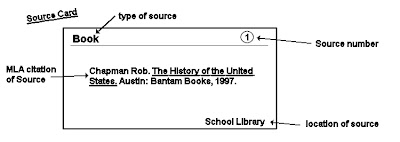
Pay close attention to the guidelines given at the bottom of each entry for specific important information that you must gather for each of the different types of sources.
Note: I would recommend that you letter and not number each of your souces. I think it is easier to keep them separate. Then, when you tie a notecard to a source you can use a letter and a number in the upper, right hand corner to indicate "which" source your note cards came from. Also note that the second line (and all others after it) of this MLA Entry should be indented. I also find it important to list the ISBN number, call number or location in the bottom left corner if one needs to find the source again for reference.
Journals: Printed Journals, Journal Article with Multiple Authors, Information from an Online Journal, Full-Text Article from a Database.
Magazines: Printed Magazines, On-Line Magazines, Full-Text Article from a Database.
Books: Book with a Single Author, Book with Two Authors, Book with Three or More Authors, Electronic Book, Article from Within a Book, Encyclopedias and Other Multi-Volume Books.
Do you want even more help? See Noodle Tools and Son of Citation Machine below.
Noodle Tools
Noodle Tools is a free tool to easily create MLA Works Cited pages. You need to go to the homepage, sign up for a free account and the site will take you through all of the other steps. Try it! You'll love it.
http://noodletools.org/
Son of Citation Machine
Citation Machine is one of many on-line cites that will assist a student who has gathered all of the "vital" information about sources: journals, books, newspapers, primary sources, other sources. Please have all of the important information collected if you want this "short-cut" to work for you. Also, make sure that you choose MLA as your "style".
http://citationmachine.net/
Duke Universities Libraries Site
This is a great site to help you understand how to handle "in-text" citations and "works cited" entries. Please make sure that you choose the Modern Language Association (MLA) entry. This site shows students how to handle "works cited" entries for a variety of other styles: APA, Chicago, Turabian and CSE. Scroll down for web-site link.

Pay close attention to the guidelines given at the bottom of each entry for specific important information that you must gather for each of the different types of sources.
Note: I would recommend that you letter and not number each of your souces. I think it is easier to keep them separate. Then, when you tie a notecard to a source you can use a letter and a number in the upper, right hand corner to indicate "which" source your note cards came from. Also note that the second line (and all others after it) of this MLA Entry should be indented. I also find it important to list the ISBN number, call number or location in the bottom left corner if one needs to find the source again for reference.
Journals: Printed Journals, Journal Article with Multiple Authors, Information from an Online Journal, Full-Text Article from a Database.
Magazines: Printed Magazines, On-Line Magazines, Full-Text Article from a Database.
Books: Book with a Single Author, Book with Two Authors, Book with Three or More Authors, Electronic Book, Article from Within a Book, Encyclopedias and Other Multi-Volume Books.
Newspaper Articles: Printed Newspapers, Online Newspapers, Full-Text Article from a Database.
Primary Sources: Letters, Interviews, Motion Picture, Online Digitized Collection.
Other Materials: Web Page, Online Posting, Email Message, Book Reviews, Government Documents
http://www.lib.duke.edu/libguide/cite/works_cited.htm
Do you want even more help? See Noodle Tools and Son of Citation Machine below.
Noodle Tools
Noodle Tools is a free tool to easily create MLA Works Cited pages. You need to go to the homepage, sign up for a free account and the site will take you through all of the other steps. Try it! You'll love it.
http://noodletools.org/
Son of Citation Machine
Citation Machine is one of many on-line cites that will assist a student who has gathered all of the "vital" information about sources: journals, books, newspapers, primary sources, other sources. Please have all of the important information collected if you want this "short-cut" to work for you. Also, make sure that you choose MLA as your "style".
http://citationmachine.net/
Tuesday, March 3, 2009
DAILY ORAL LANGUAGE: ACT Preparation--Grammar, Usage & Mechanics & Rhetorical Skills Quiz 1
 Daily Oral Language Assignments
Each day of Mr. McLaughlin's English 10B Class will begin with a short "sponge" activity. On some days we will begin with the ACT preparation assignments like the ones listed in this entry.
On other days we will be working with ACT/SAT Vocabulary words. For your convenience & for your study, these are being posted here for your convenience and to study for our in class quizzes.
Your learning of this material will be covered on our quizzes. We will have a quiz each two weeks.

COMPLETE ACT TEST PREPARATION.doc
ACT Test Preparation Passage I.1, Day 1.doc
ACT Test Preparation Passage I.2, Day 2.doc
ACT Test Preparation Passage I.3, Day 3.doc
Monday, December 1, 2008
English 10B Vocabulary: Unit 2 SAT/ACT Words
 2.1 ARDUOUS (Ahr joo us) hard, difficult, tiresome
Memory link: the arduous snow covered trail is hard on us
It was an ARDUOUS climb up the 5 mile hill.
The pace of the track meet was ARDUOUS and left many runners tired and ready to go to sleep.
The assignment given the recruits was ARDUOUS, twenty miles with full packs in the hot sun.
Swimming three miles was the most ARDUOUS excersize Jeannie ever had.
The long, ARDUOUS boat trip was made even worse by stormy seas and much seasickness.
It was the most ARDUOUS puzzle I had to ever solved, it took days to solve it.
2.2 ASUNDER (uh SUN dur) separate parts; apart from each other in position
Memory link: The thunder tore the young lovers asunder
Friday, December 5, 2008
The big storm made the houses all ASUNDER. Nothing was one piece anymore.
2.2 ASUNDER (uh SUN dur) separate parts; apart from each other in position
Memory link: The thunder tore the young lovers asunder
Friday, December 5, 2008
The big storm made the houses all ASUNDER. Nothing was one piece anymore.
When the earthquake stopped, and we came up from our shelter, we found the city had been torn ASUNDER and not one single building was left standing.
Our team lost its unity and became a group of individuals who played entirely for themselves, ASUNDER from each other.
Bowling pins ASUNDER from each other when the ball hit them.
Their relationship was brought to an ASUNDER; they couldn’t be together any longer.
2.3 ASKEW (uh skew) to one side; crooked; awry; a sidelong look of contempt
Memory link: Curlys pool cue had become askew.Friday December 7, 2007
Thursday, December 4, 2007
Our backbones have an ASKEW bend to them.
After the flood receded, the bridge was found to be ASKEW of the road which connected to it.
The tire wouldn't fit on the car beacause in the accident the axle had been bent ASKEW.
The speaker looked ASKEW at the heckler at every interruption.
Marcy looked at Jan with an ASKEW look because she said a rude comment.
The picture was too ASKEW; nothing fit together.
2.4 BELEAGUER (be Lee gur) to besiege; beset; surround, harass
Memory link: the little leaguers beleaguered the big leaguers.
Friday, December 5, 2007.
The ants BELEAGUERED the ham sandwich at the picnic.
In World War II, the Russian city of Staligrac was BELEAGUERED by the German ARmy for five months before it fell to the Germans.
During his last year in office, Richard Nixon was a BELEAGUERED president, struggling to fight off the Watergate scandal.
In the midst of important negotiations, the union official asked his staff not to BELEAGUER him with insignificant details.
Tom BELEAGUERED Jimmy at recesses all day long. Jimmy cried.
My mom was BELEASGUERING me with many questions so I told her to back off.
2.5 DULCET (DULL set) melodious, soft, soothing
Memory link: If you don’t like opera, even the most Dulcet tones of the finest sopranos make for a dull sit.
The DULCET sound of her voice could put any baby to sleep.
Senator Kramer was a political campaigner who could hypnotize an audience with sweet words and DULCET tones.
Jeff's parents declared there was nothing DULCET about the rock-and-roll music that shook the house from his room every morning as he dressed for school.
The radio therapists voice was DULCET and calmed her listeners down and made them comfortable sharing their problems on the radio with thousands of listeners.
Some people need "white noise" to sleep as they find it DULCET. It doesn't work for me and drives me crazy. I need the room to be silent to sleep.
2.6 EFFACE (uh FACE) to rub away
Memory link: how to efface a face by erasing it
Sometimes people who commit crimes will EFFACE all evidence.
Some people need "white noise" to sleep as they find it DULCET. It doesn't work for me and drives me crazy. I need the room to be silent to sleep.
2.6 EFFACE (uh FACE) to rub away
Memory link: how to efface a face by erasing it
Sometimes people who commit crimes will EFFACE all evidence.
We came upon a cemetary by the sea. Many of the headstone inscriptions had been EFFACED by the ravages of time, but we could make out many that were well over two hundred years old.
To assure that he left no clues, the thief EFFACED his fingerprints from the stolen car.
Someone vandalized the museum paintings by EFFACING each one with red spray paint.
Over the years, the color on the pictures started EFFACING slowly.
I EFFACED the dirt off my arms.
2.7 HISTRIONIC (his tree AHN ik) overly dramatic, theatrical
Memory link: Professor Bradley likes his history on the histrionic side
Jess was always HISTRIONIC about everything. Even about the littlest things possible.
As soon as you would mention thw word wrinkle the middle-aged actress would fall into a state of HISTRONIC tears.
Everything Michael said was on the swaggering, HISTRONIC side, as if he were the coolest guy on campus.
The children's HISTRONICS when they couldn't find their toys made everyone uncomfortable.
The HISTRIONICS within the movie made it more exiting.
The movie was too HISTIONIC for me too handle.
2.8 MILIEU (mill you) environment or surroundings
Memory link: the boys’ locker room showers were a milieu of mildew
After a long sea journey, a sailor on land for the first days feels out his MILIEU.
The proper MILIEU for raising a family is a home setting with loving parents who understand child rearing; something every parent must work at and not take for granted.
I always love the MILIEU in an airplane; its always friendly.
Its always a good MILIEU when the house is clean.
Its always a good MILIEU when the house is clean.
The New York Stock Exchange is a MILIEU of frenzied activity during trading hours.
2.9 PORCINE (pore sein) reminiscent of or pertaining to a pig
Memory link: it was a poor scene when mark arrived with his porcine date
Thursday, December 4, 2007
Her skin had a PORCINE color that bugged me.
After an around the world cruise, where each meal is a grand feast, Bob and Helen returned home with PORCINE figures.
She had a PORCINE attitude about food; that is to say she would eat anything and everthing.
Over the college years he has gotten the PORCINE. look.
Bob was a PORCINE when it came to food but he was still skinny.
2.10 QUIXOTIC ( kwik SAHT ik) idealistic and totally impractical
Memory link: Jim, the messenger, is not idiotic, he’s just quixotic.
Wednesday, December 3, 2007
Her freinds thought her QUIXOTIC when planning big parties; she just loved to dream big.
Professor Callan said it is QUIXOTIC of society to ignore the world's environmental problems.
Puttingall taxpayers on the honor system is a QUIXOTIC suggestions.
Sue had the most QUIXOTIC ideas of what her life would be like if she ever won the lottery.
The man's behavior was QUIXOITIC, he sat outside of mcdonalds thinking he would get free big macs everyday.
Sunday, October 26, 2008
Demonstration Speech Topic Selection
 CRITERIA FOR CHOOSING A DEMONSTRATION SPEECH TOPIC
The goals of your demonstration speech could be: to demonstrate a process and give the audience information while using visual aids; or to show how to do something; or how something is done; or how to make something; or how something works.
Choose a topic that you know and enjoy. Your speech will be more successful and easier to do if you use this criteria. If you can't come up with good public speaking topics for a demonstrational presentation speech, then use the subjects listed below for inspiration.
Before You Take that Step, Consider the following:
 -Is it something you know how to do well?
-Is it something your audience would like to learn?
-Is it a process that can be done in the classroom with the materials that we provide? (table, blocks, cutting board, knives, refigerator, freezer, microwave--please DO NOT bring knives to schooo)
-Is it a process that will result in a finished product?
-Is it something you can accomplish in the allotted time? (5-7 minutes)
-Is it something you can safely accomplish in the room?
-Is it something you can do legally in school? (no weapons, animals, alcohol or controlled substances)
-Which of your choices have enough potential to offer your audience valuable information?
Remember audience when you choose your topic.
Who are they?
What are their interests?
What do they like?
What are their needs?
Use these lists of demonstrative speech topics to develop your own topics for a demonstrative speech. It can be anything you like. As long as you are able to present the steps of the demonstration or process speech topics.
Topic Ideas--Food--Demonstrate HOW TO:
bake a pie,

decorate a cake,
make a non-bake cookies,
make a favorite family cookie,
make a better than hitting the lottery cake,
make different flavors of beef jerkey,
make an icee,
make a non-bake cookies,
make a favorite family cookie,
make a better than hitting the lottery cake,

make different flavors of beef jerkey,
make an icee,
make puppy chow,
make a fruit cake,
make blueberry pancakes,
make muffins,
grill a steak,
make a fruit cake,
make blueberry pancakes,
make muffins,
grill a steak,
make seven-layer dip,
make a Caesar salad,
make an Orange Julius,
make variations on grilled cheese,
make an omelette,
make a smoothie,
make homemade ice-cream,
Topic Ideas--Non Food

HOW...
to set a dinner table for a formal dinner,
to plan the perfect date,
to make a pinata,
to pot or repot a plant,
to make a birdhouse,
to arrange flowers,to polish shoes,
to stencil glass,
to make stationary,
to stamp greeting cards,
to make ornaments,
to color eggs,
to scrapbook,
to make a photo album,
to paint a shirt,to make paper flowers,
to do wood burning,
to frame a picture,
to make boxes,
to make a dream catcher,
to finish furniture,
to hang wallpaper,
to make a basket,
to make a spool doll,
to make an Easter tree,
to make a dryer vent pumpkin,
to fix a bike tire,
to iron clothes,
to cross stitch,
to make a terrarium,
to set up a fish tank,
to tie a tie,
to make a wreath,
to wrap a package creatively,
to silk screen,
to carve wood,
to tool leather,
to repair a lamp,
to make a winter survival kit,
to carve a pumpkin,
to make a centerpiece,
to make a beaded necklace,
to make paper,
to tie dye,
to braid a belt,
to make candy airplanes or trains,
to make a wooden stool,
to make Playdough or Silly Putty,
to make a planter,
to dry flowers
to be a vegetarian
to fix a flat tire
to create a Halloween mask
to clean your car
to play piano
to change a bank cheque
to dress for a dance
to play a computer game
to make a blog
to make a web site
to organize a surprise party
to print a digital photo
to eat oysters
to register for voting
to make special coffee drinks
to read music notes
to learn playing guitar
to use your breath when you sing
to make your own root beer
to make your garden full of flowers year around
to build a resume
to clean your swimming pool
to clean your golf clubs
to make a fast summer salad
to make a new candle of old ones
to make your own wedding dress
to organize your wedding
to make a water-colour
to build a shed
to prevent injury
to develop the best serve in a tennis game
to knot a carpet
to manage stressto relax
to become a good actress
to become a famous filmstar
to write a filmscript
to write a business-like letter
to harvest honey
to serve breakfast in bed
to blow a glass
to train your brains
to make a genealogical tree
to start a bed & breakfast
to become a policeman
to climb a building
to planning a party
to run a formal meeting
or demonstration speech topics related to yóur favorite sports
And so on ...
Other Ways to Get Ideas
And so on ...
Other Ways to Get Ideas
Another way of inventing demonstration speech topics is by associating. Look at the general categories below. Can you come up with any good how to demonstrative speech ideas?
Food and Drink, Household, Sports, Recreation, Health & Beauty, Home Improvement, Decoration, Cars, Government Science, Nature, College Games, Culture, Etcetera ...
Delivery Of Your Demonstration Speech Topics
First and for all: think about the rules and time limit of the public speaking assignment. And apply these eight public speaking speech tips for delivering your demonstration speech topics:
1. Visual aids, like objects, actual items, models or drawings can help you.
2. Include personal stories and examples to illustrate your topics for a demonstrative speech.
3. Provide each audience member materials and ingredients to practice with.
4. Insure everyone is participating.
5. Look around you and see if your audience is following you.
6. Ask yourself if someone in the audience has to assist with your demonstration.
7. Close your speech with a memorable summary.
8. Ask if there are any questions about your demonstrative speech topic ideas.
By now, you developed a blueprint for a good demonstration speech topic.
CLICK HERE for a cool on-line topic selection tool. Or scroll down for Mr. McLaughlin's list of topics.
Didn't get your topic in the book? CLICK HERE to send an email reserving your topic.
Have another idea to add to the list? CLICK HERE and if it's good, we'll add it to the list.
Wednesday, October 1, 2008
The LCHS Opinion/Conviction Speech
 YOUR OPINION & CONVICTION SPEECH IN SPEECH I
Originally Posted September 24, 2007 this term. Posting date changed to place the article higher on the blog for student's convenience.
Choose a topic about which you have a strong opinion. Remember, topics are first-come, first-served. Only one speech per topic, per class.
It is our goal in this speech to teach you how to support an opinion and make an argument with support. Don't be afraid of this, though. You already do this all the time. Everytime you reach a conclusion about something, your personal experiences or the experiences of others lead you to your conclusion.
You will share your opininion for the rest of your life. We want to make sure that our graduates know how to share valid opinions in public. Remember, an opinion by itself without support may let others see you as uneducated. Years from now when you're on a church council, a scout leader, a member of the PTA, local government or you're just visiting with family, what we learn here will serve you. THIS IS EASIER THAN MANY OF YOU WILL WANT TO MAKE IT. RELAX, YOU CAN DO THIS!
This IS NOT a researched speech. It is a speech that you will support with your own experiences, the experiences of friends, of family members or others. You will need three "reasons" why your opinion is valid. Then you will need to support your reasons with stories or personal experiences.
ON-LINE VERSIONS OF THINGS WE LEARNED IN CLASS
Don't understand the Introduction, Conclusion or How to Build a Main Point? Click here for more information.
ELIGIBILITY: To be eligible for this 3-6 minute Opinion Speech you need to have the following pieces complete that are listed as REQUIRED. Some of these links are to help you find information quickly on our blog to help you and are not required.
TOPIC SELECTION
(1) CLICK HERE to send an E-Mail to Mr. M. with your topic if it is not in the book. It must be put in the book and compared to other topics there. Remember, first come, first served. REQUIRED FOR THIS SPEECH: Your topic must be in the classroom book and must be approved by the instructor.
PRE-SPEAKING BLOCK
(2) CLICK HERE for a "review" on how to write a Pre-Speaking Block with a General Purpose and a Specific Purpose (known as the Pre-Speaking Block). REQUIRED FOR THIS SPEECH: A Pre-Speaking Block done before you begini writing your speech. This helps you make good speech writing choices.
(3) CLICK HERE for a "review" on how to write an Audience Analysis Statements as we taught in the last speech. REQUIRED FOR THIS SPEECH: An Audience Analysis Statement of an audience that is made up of students, teachers, parents, administrators, school board members and citizens.
INTRODUCTION
(4) CLICK HERE for a "review" of the five goals one should achieve in writing a good introduction. REQUIRED FOR THIS SPEECH: A manuscripted Introduction.
(5) CLICK HERE for a "review" of the types of Attention Getters (with examples) that we learned in class during the Peer Biography Speech. REQUIRED FOR THIS SPEECH: Three Attention Getters that are at least four sentences long each.
(6) CLICK HERE for a "review" on how to write a thesis statement as was taught in class. REQUIRED FOR THIS SPEECH: A thesis statement made with a salutation, thesis base and strong preview.
(7) CLICK HERE for a "review" of how to write a relevance statement. REQUIRED FOR THIS SPEECH: A relevance statement that includes three different reasons for the audience to listen. This is a minimum. More is fine.
(8) CLICK HERE for a template showing how to complete the three required bulletin boards. REQUIRED FOR THIS SPEECH: A completed bulletin board for each of your main points.
(9) CLICK HERE for the required manuscripted Introduction Template. REQUIRED FOR THIS SPEECH: A one-sheet manuscripted introduction.
BODY
(10) CLICK HERE for the required T-Chart/Template for MP I of your Opinion Speech. REQUIRED FOR THIS SPEECH: An important reason (T-Chart) for the "more important argument that you will offer."
(11) CLICK HERE for the required T-Chart/Template for MP II of your Opinion Speech. REQUIRED FOR THIS SPEECH: A more important reason (T-Chart) for the "more important argument that you will offer."
(12) CLICK HERE for the required T-Chart/Templage for MP III of your Opinion Speech. REQUIRED FOR THIS SPEECH: The most important reason (T-Chart) for the "most important argument that you will offer."
(13) CLICK HERE for another copy of the rubic given to you in class. You need this signed by a parent/adult showing that you discussed or delivered this speech for an adult.
(14) CLICK HERE for the required manuscripted Conclusion Template. REQUIRED FOR THIS SPEECH: A manuscripted conclusion of the speech.
(15) CLICK HERE for a "review" of the things any good speaker/writer should accomplish in a good conclusion as we learned in class.
(16) CLICK HERE for a "review" of the types of clichers with examples that one might use for a speech. These were recently taught in class. REQUIRED FOR THIS SPEECH: A strong clincher that effectively leaves the audience with a final thought or a series of final thoughts.
(17) CLICK HERE for examples of the types of evidence and support that one should us to support his/her opinions with evidence. The opinion speeches should be supported by evidence. REQUIRED FOR THIS SPEECH: Two pieces of support at minimum for each of the Main Points in the speech.
GENERAL
(18) CLICK HERE for an overview of what each TEMPLATE should contain. REQUIRED FOR THIS SPEECH: Five template styled pages to carry to the podium with you that encourages "extemporaneous speaking."
ELECTRONIC COPIES OF SPEECH OPINION RUBRICS
TO BE USE IN SELF, PARENT AND INSTRUCTOR EVALUATION
Opinion Speech Self-Evaluation.doc
Opinion Speech Teacher Evaluation page 1.doc
Opinion Evaluation Speech Teacher Evaluation page 2.doc
Opinion Speech Pre-Speaking Block
Opinion Speech Pre-Speaking Block & Modified Thesis
For today's homework you need to write a GP, an SP and an AAS for you Opinion Speech. I also need you to brainstorm on a web/map 5 reasons that your opinion should be supported by others. And by others we mean that you should consider other students, teachers, school administrators, parents, community patrons and school board members.
For the first speech we taught you to write a thesis the following way:
Today I will insert general purpose (entertain, inform, persuade, convince, etc.) you that insert subject and opinion of subject by insert -ing word (examining, discussing, studying): (1) insert first main point; (2) insert second main point; (3) insert third main point; and (4) insert fourth main point.
For this speech you will need to write a revised thesis (without the "Today I will and GP")
The revised and less rigid thesis should look like this. This is closer to what a thesis should look like in your writing:
Start by stating your subject and your opinion of your subject--Thesis Base (short and to the point) as can be seen by insert -ing word (examining, discussing, studying): (1) insert first main point; (2) insert second main point; (3) insert third main point; and (4) insert fourth main point.
Subscribe to:
Posts (Atom)